Tuesday, July 18, 2023

Exploring Yeats Country

July 18, 2023

We set off for Sligo early in the morning, before the Rusty Mackerel staff showed up at 8:00 am.  It was supposed to be another big hiking day.  The plan was to hike the two big mountains around Sligo - Benbulben in the morning and Knocknarea in the afternoon.  But the Sliabh Liag hike took its toll on both Kati's and Tyler's knees, so we called a bit of an audible and decided to skip the morning hike in order to preserve their knees for the afternoon.  Instead, we decided to stop off at the Glencar Waterfall in County Letrim.  It was an easy 0.4 mile "hike" from the road along a paved path, but Kati's knee was still bothering her a lot, so she opted to nap in the car while Tyler, Morgan, and I headed up to the waterfall.

The path to Glencar meandering along the side of the cascading stream, up through the wooded glen to the main attraction.  It was easy to tell when we were close to the waterfall because the temperature dropped by what felt like 15 degrees.  At 50 feet tall, the romantic waterfall is something to behold and it's easy to see how it inspired William Butler Yeats's poem 'The Stolen Child':

Where the wandering water gushes
From the hills above Glen-Car,
In pools among the rushes
That scarce could bathe a star,
We seek for slumbering trout
And whispering in their ears
Give them unquiet dreams;
Leaning softly out
From Ferns that drop their tears
Over the young streams.
Come away, O human child!
To the waters and the wild
With a faery, hand in hand,
For the world's more full of weeping than you can understand.

The shores of Glencar Lake, into which the waterfall flows, were also serenely beautiful and calming.  It turned out to be the perfect interlude for the morning drive into Sligo.

From Glencar, we drove to the Carrowmore Megalithic Cemetery. The name Carrowmore comes from. the Irish Cheathrú Mhór, meaning "the great quarter." It is a very fitting name for one of the largest clusters of megalithic monuments and tombs in Ireland (and in Europe). There are 30 surviving tombs at the site, all constructed around 6,000 years ago in the 4th millennium BC. The most in-tact and impressive of the tombs is Tomb 51, known as Listoghil, which reaches a height of approximately 8 feet and included a chamber large enough to walk in. It was very cool!

Our exploration of cairn culture continued with Knocknarea (Cnoc na Riabh). At 1,073-feet tall, it is a striking mountain overlooking Sligo and the Atlantic coast. At the top sits Queen Maeve's Cairn (Miosgán Meadhbha). Outside of Brú na Bóinne in County Meath, it is the largest cairn in Ireland, measuring 180-feet wide and 33-feet high. Legend has it that mythical Queen Maeve (Medb) is buried there, standing upright in her armor and holding her sword and shield, facing north toward her eternal enemies in Ulster. The hike up Knocknarea was a beast! The path seemed to get steeper and steeper the closer you got to the top, but the view was well worth it. The cairn was pretty incredible, but the views of the surrounding area were the real stars.

The summit offered an outstanding view of flat-topped Benbulben (Binn Ghulbain), which at 1,726-feet is visible from any point in County Sligo. Though I was sad about skipping our ascent of Benbulben that morning, the real beauty of the mountain is looking onto it, not out from it. It really was something! The other interesting sight we saw from the top was in Sligo Bay. The tide had gone out considerably and there were dozens of cars just driving across the partially dried up bay! We all agreed that the idea of driving across that soft sand was not something we wanted to try.

After carefully descending Knocknarea, we headed over to Strandhill, which is a quaint littler surfing town. More importantly, it's where we were going to have a seaweed bath! I had booked these baths months ago and yet remained skeptical about whether I would enjoy sitting. in a bath with slimy seaweed when I don't like touching it to begin with. Nevertheless, it has been a traditional therapeutic technique in western Ireland for centuries, so I felt like I had to try it. Plus, I'd read a decent amount of scientific literature discussing how seaweed baths lower body stress, relieve skin conditions, treat muscle aches, and joint stiffness, and improve circulatory problems. They started us off in a steam room to open our pores, and then Kati and I hopped in our side-by-side bathtubs overlooking the Atlantic ocean. Somehow the experience was both gross and enjoyable all at once. They encouraged us to drape the seaweed all over our bodies and in our hair. Doing so left a really slimy film that felt very similar to the inside of an aloe leaf. Still, I kind of loved it and there is no denying that the experience left us all relaxed beyond belief.

Having thoroughly explored the surrounding area, it was time to head into Sligo proper. We were staying at The Glasshouse, which is a very modern, mostly glass, hotel built in the middle of downtown Sligo, right on the Garavogue River. The modernity of the hotel caused a bit of an uproar with the locals when it was built a few years back, but it was a great spot and we had balconies overlooking some rapids on the river. We took a whirlwind tour of the town, stopping to see the memorial statue of W.B. Yeats and peeking into the Sligo Abbey, which was built around 1252, burned down by an unattended candle in 1414, rebuilt, and then further destroyed during a rebellion in 1641. The quaint little town also has several beautiful bridges crossing over the river along the gently curving streets of shops and pubs. We ended our tour in Thomas Connolly's which is the oldest pub in Sligo, having been first licensed in 1861. Thomas Connolly himself even became mayor of Sligo in 1890!

We had dinner reservations at another gastropub in town - Hargadons (est. 1868). It is a charming little place with uneven floors, antique signage, and snug corners. Plus, the food and drinks were outstanding. Thus far in the trip, Morgan had found a somewhat surprising and embarrassing drink that she really liked - the Pornstar Martini. As we were ordering drinks, she gravitated toward the passionfruit martini. I asked her if she was sure she didn't want a Pornstar Martini, at which point the waiter quipped, "They're the same thing." Between the four of us, we got an ungodly amount of food - seafood chowder, flame-grilled Irish ribeyes, and mussels. We ordered two things of mussels and they brought out two large pots full of them! It was so much food that we didn't even come close to finishing them. The other funny moment happened when I went to the bathroom. There was an English guy in there who insisted on talking to me and asking me where I was from. I politely told him and asked him where he was from. He said, "Lincolnshire, England" and asked me if I'd ever heard of it. I said that I had, though I wasn't super-familiar with it and offered up the fact that I had lived in England for a number of months as a child. He asked me where, and when I said Woking, he said he'd never heard of it!

After dinner, we headed back to Thomas Connolly's for live music. It was a trio of girls who looked like they may have been in high school, or perhaps they were young university students. Regardless, they were great and just jammed out on Irish songs on their violins and harp. We ended up sitting with a trio of women from Canada and, after pushing them on where specifically they were from "outside of Toronto," learned that they live in Burlington which is where my best friend and college roommate was from and still lives. Somewhat surprisingly, they didn't know Shawn or his family, but they do all teach at the local high school where we went for breakfast after a freezing cold 10K race a number of years ago! Talk about a small world! We had a blast chatting with them while listening to the music before finally turning in to get some rest for yet another eventful day in the morning.

Monday, July 17, 2023

Walking in the Footsteps of Giants

July 17, 2023

Today was the day on the trip that I had been most looking forward to. In fact, I planned the entirety of our jaunt through Northern Ireland, and eschewed visiting the south, because I wanted to see the Giant’s Causeway (Clochán an Aifir). It is the only UNESCO World Heritage Site in Northern Ireland. We were also staying in the Causeway Hotel because that meant we could get down to the Causeway early in the morning, before the crowds. The plan worked like a dream and the Causeway did not disappoint.

According to legend, the Irish giant Finn McCool (Fionn mac Cumhaill) built the Causeway after the Scottish giant Benandonner challenged him to a fight. When Finn crossed the bridge and realized Benandonner was much larger, he returned to Ireland where his wife Sadhbh disguised him as a baby and tucked him in a cradle. When Benandonner saw the size of the "baby," he decided that its father (Finn) must be a giant among giants, so he fled back to Scotland in fright, destroying the causeway behind him so that Finn would not be able to chase him down. According to legend, all that remains from the destroyed causeway are its ends—the Giant’s Causeway in Ireland and the island of Staffa in Scotland.

We set off down to the Causeway around 7:30 am amidst overcast skies but no rain. There literally wasn’t another soul there when we got down. After spending a solid 90 minutes down at the Causeway, we set back up to the hotel for breakfast, followed by a quick stop off in the Visitor Experience. It was a good thing we went down to the Causeway early, because when we walked out of the hotel after breakfast, it was pouring rain!

Because we had retooled our plan to stop back by the Carrick-a-Rede Rope Bridge, we started our way back east along the Causeway Coast. Our first stop was Dunseverick Castle (Dún Sobhairce), which was first fortified by the ancient chieftain Sobhairce by at least the 5th century, became the center for the Earls of Ulster between 1250 and 1350, and the stronghold for the MacDonnells beginning in 1560. Saint Patrick is recorded as having visited the castle where he baptized Olcán, the future Bishop of Ireland. The castle was finally captured and destroyed by Cromwell's troops in the 1650s and all that remains today is the gatelodge.

From there, we drove east, passing the white sand beaches of Whitepark Bay. The four of us spent an embarrassing amount of time discussing how it could possibly be that there were people down on the beach on such a chilly and rainy morning only to finally realize that they weren’t people at all, but cows! Our next stop was down winding and treacherous road in Ballintoy (Baile an Tuaighe) Harbor, which is where they filmed a number of scenes for Game of Thrones, including those for the Iron Islands’ Lordsport Harbour. The harbour was built in large part because of the nearby lime kiln that was built in the 1700s and redeveloped a century later. Additionally, in the late 1800s, sett stones, hewn in nearby quarries were exported from the harbour to pave the streets of fast-developing industrial cities like Dublin and Liverpool. The harbour offered yet another incredible view of the northern Irish landscape.

Finally, it was time to head back to the Carrick-a-rede Rope Bridge, and I hadn’t gotten any notification that the bridge was closed today, so we were all excited and hopeful. The bridge itself is 60-feet long and 3-feet wide, spanning the 90-foot-deep chasm between the sea cliffs and the tiny island of Carrick-a-Rede. The island's name comes from the Gaelic Carraig-a-Rade, which means "The Rock in the Road." It was named such because the island represented an obstacle for the migrating Atlantic salmon. The rope bridge was first erected by fishermen in 1755, but the fish are long gone now. because of fishing pressure at sea and river pollution. The last fish was caught at Carrick-a-Rede in 2002 when the last fisherman on the island retired after 30 years.

The trail from the car park to the bridge was a little over a mile, winding up and down the sea cliffs and past fields and fields of sheep. As we were walking down, we passed a group of four girls - seemingly American college students - who made a series of less-than-astute observations about the Troubles and the political challenges of Northern Ireland. The penultimate decision they reached to resolve these political challenges was that if they just changed the name of Londonderry to “Derry Londonderry.” Apparently that simple change had the power to resolve literal centuries of religious and political disagreement. At that point, I had to speed walk to get as far away from their ignorant idiocy as possible.

The bridge and the island were both really cool! Kati had been on the fence about crossing the bridge before the trip, but managed to summon the courage to do it (and enjoy it). There’s still an old fisherman’s house built into the steep side of the island and all I could think about the whole time was how it just doesn’t seem possible to live in a house like that…on an island like that! Like so many things along the Causeway Coast, it was just mind blowing. Equally mind blowing was the fact that, on our walk back, Kati turned to me and said, “Is she wearing a Transy jacket?!” As it turns out, not only was she wearing a Transy jacket, but her husband (also wearing a matching jacket) is the President of Transylvania University! We stopped to chat with them for a few minutes and marvel about how small the world is and how, without fail, when we go somewhere, we run into other people from Kentucky.

We made one last stop in County Antrim before setting off for the wild Atlantic coast of Donegal in Portrush (Port Rois) to grab a quick bite to eat. Portrush was packed with people and bears a lot of similarities to the Jersey Shore. It’s a seaside resort town and the focal point of the downtown area is a boardwalk full of carnival rides, putt putt, and the likes. We tried to stop off at Kiwis Brew Bar for lunch and some craft beer, but we got there at noon and they didn’t start serving food until 1:00. As much as we wanted to try it out, we had places to be and no time to linger. Unfortunately, the next several places along the street that we tried to stop at to eat were also closed, so our options were limited. Finally, we found nondescript hotel restaurant to get a burger and head back into the Republic of Ireland and on to the Irish equivalent of the Wild Wild West - County Donegal.

Donegal - The Craic Was Ninety

July 17, 2023

The drive from Portrush to Ardara should have taken about two hours, but we ran into a lot of traffic between Derry and Letterkenny, which really stressed me out because our next stop was at the Sliabh Liag Distillery and I had been looking forward to tasting their gin for months.  Even with about a 30-minute buffer, we found ourselves running late for our 4:00 pm tour by about 20 minutes.  I called the distillery at about 3:45 to let them know what was going on and see what our options were.  Unfortunately, they said that they couldn’t hold the tour up for us because by the time we showed up they would have gone through all of the safety information and the tour would be half over.  The could, however, do a tasting for us with one of their distillers.  Between the four of us, we’ve been to dozens of distilleries and we were all floored and confused by the fact that there was a safety briefing.  Oh well.  I’ve been to enough distilleries that what I really cared about was not getting a tour, but tasting their products, so everything probably worked out for the best.  The folks at the distillery were wonderful, though the lady at the front desk (whom I spoke to on the phone) was shocked that we ran into traffic in Donegal and made multiple comments about it during the 45 minutes or so that we were there.  Her confusion made sense because there really wasn't any traffic in Donegal, but it did have some of the most quintessential and stereotypical Irish scenes.  For example, while we were driving, we passed by an old man in a full, black suit and hat shoveling gravel on the road outside of a church, not to mention all of the sheep walking in and along the roads!

Our tasting guide was Declan, the son of the distillery’s owners, and he was a delight. He was born in England, spent a while living in Hong Kong, and then moved to Ireland.  His parents distill Silkie Irish Whiskey, and Declan helps his mom distill what I sought them out for - An Dúlamán Gin.  They use a 500-liter, hand-hammered copper still and five types of Donegal seaweed; one of which can only be harvested during a full moon, when the tides are right.  It turns out that Declan was actually the person who harvested that seaweed!  The An Dúlamán totally lived up to expectations!  We also tried another gin that Declan helped develop and three Silkie Irish Whiskeys.  The whiskeys are named after the mythological silkies - women who can shift their shape between human and seal.  The whiskey tasting was fascinating because Declan taught us all about peat and smokiness.  I don't typically like peated whiskeys, but it was very interesting to taste the differences between slightly peated whiskey and heavily peated whiskey.  They were actually pretty good!  After the tasting, Declan and everyone else then had a good time making fun of me as I grabbed more and more gin off of the shelves to buy.  Declan also felt so bad that about us missing our tour that he offered to take us into the back and show us around, but we declined to get on our way to the Sliabh Liag (“sleeve league”).

Though the Cliffs of Moher get more publicity, the cliffs of Sliabh Liag are higher.  In fact, they are the highest sea cliffs in Europe, plunging over 1,800 feet into the churning sea.  The hike up to the cliffs was pretty steep and followed a gravel road with dozens of sheep roaming free throughout the area.  Kati desperately wanted to pet one and tried, but it did not go well and the irritated sheep clip-clopped away.  There aren’t words to describe the sublimity of the cliffs, and the higher we climbed, the more unbelievable it got.  Kati and Tyler were both having some knee pains but couldn’t turn down climbing higher and higher.  By the time we reached the pinnacle of our climb (but not the highest point on the cliffs), it was about 7:00 pm and we were getting hungry so we started our trek down.

We were holding up for the night at the Rusty Mackerel, which is the closest inn to the Sliabh Liag and, surprisingly for a pub in the middle of nowhere, named the Best Gastro Pub in Ireland in 2022.  When I opened the door to the pub, I was met with a slew of old Irish guys loudly carrying on in Irish in a dark wooden room that had been decorated with random signs and pictures over the course of decades.  It was exactly what I had expected Donegal to be!  We also lucked out because we rolled in right at 8:00 and the kitchen closed at 8:00, but they promised to squeeze us in.  Tyler and I both went with the prawns and monkfish.  It was kind of like shrimp scampi, if you replaced all of the pasta with cheese!  Definitely good, but also way too much food.

The rooms left something to be desired.  They appeared to be rapidly built permanent trailers behind the pub, but they got the job done and we were only going to be in them for a matter of hours.  At 9:30, the live music started and the pub rapidly to fill up with locals.  Morgan headed off to bed and Kati followed after her a little while later, leaving Tyler and me to our own devices.  The guitarist was great and played a nice mix of traditional Irish songs and modern music.  

Tyler - no surprise to anyone - managed to befriend some of the locals.  When getting us drinks at the bar, he was talking to one guy about how we had hiked up the Sliabh Liag earlier in the evening and how many sheep there were just roaming around.  They guy said, "Oh those are Martin's sheep!" and pointed over to a guy across the bar who raised his glass in acknowledgement that he was, in fact, Martin.  There was also another rowdy group of locals right behind us, clearly speaking Irish.  The were having a grand time and we couldn't understand a word they were saying.  That is, until one of them switched from Irish to English and very clearly said over the quieted bar, "And that's when I said once you go black you never go back!"

I headed back to the room around 10:30 pm so that Kati and I could call the kids together, but Tyler stuck around for a bit longer and said it got a bit rowdy.  It was John's birthday and, at some point, the local bus driver brought his bus to pick John up and take him home.  Apparently his wife and daughter we already there at the bar celebrating, and instead of quietly heading out, when he showed up, he was whisked onto the dance floor and passed around square dance style.  The Rusty Mackerel was everything I expected from Donegal and so much more!

Sunday, July 16, 2023

Exploring County Antrim

July 16, 2023

From Belfast Castle, we set off on our journey through County Antrim and its mystical landscape of rock formations, ruined castles, and wooded glens.  Our first stop in Antrim was at the Dark Hedges.  They were planted by the Stuart family in the 18th century as the formal entrance to their property, but the gnarled and intertwined beech trees became famous as the site as the Kingsroad in Game of Thrones.  Before the trip, I had heard that the Dark Hedges, while really cool, were a bit of a disappointment because there were tons of tour buses parked nearby and too many people to truly appreciate the site.  That, however, was not our experience.  Though there were a decent number of people, it wasn’t overwhelming and the street was still very cool.

For lunch, we stopped off in the harbor-town of Ballycastle, which marks the eastern end of the Causeway Coast, and found a small pub to grab a quick bite before continuing our tour. The town was everything you would expect in rural Ireland - narrow roads winding up and down rolling hills, flanked on both sides with picturesque and colorful storefronts. We also got to drive along the harbor as we started our trek down the Causeway Coast.

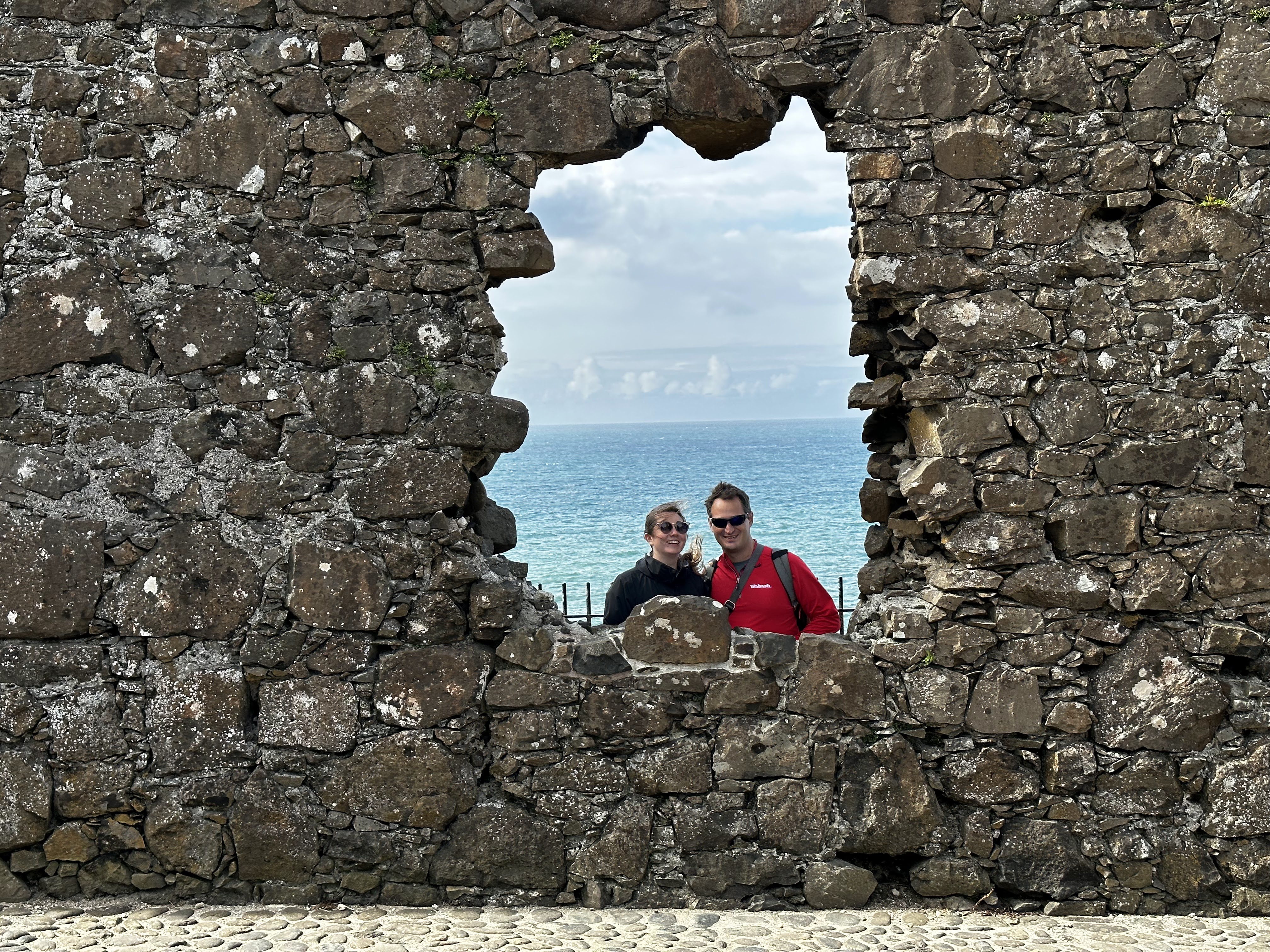
Our first stop along the coast was Kinbane Castle (Caisleán Ceinn Bán), which was a late-add to fill our puffin void and perhaps the highlight of the day. The ruined castle was built in 1547 by Colla MacDonnell, then rebuilt in 1555 following an English siege. What is left of the castle sits on a limestone headland jutting out from basalt cliffs with incredible views of both Rathlin Island and Scotland. We had to descend 140 stairs from the top of the cliff to reach the castle, but wow! I can’t imagine a more picturesque location.

Next on the itinerary was the Carrick-a-Rede rope bridge, but we arrived to find that it was closed for the
day due to extreme winds. Luckily, everything along the Causeway Coast is relatively close together and I was able to rejigger our plans tomorrow and get reservations to come back to the bridge in the morning. We did walk down to the rope bridge, which was a much longer walk than I had anticipated (~1.2 miles), but then set off to Dunlace (Dún Libhse) Castle. In contrast to Kinbane Castle, Dunluce (“dun-loose”) Castle is pretty well preserved for being centuries old. It is perched atop a dramatic basalt crag and there is a narrow bridge that leads from the former guest lodgings and stables across a dizzying gap to the main part of the fortress. In the 16th and 17th centuries, the castle was the seat of the MacDonnell family (the earls of Antrim from 1620). What amazed me the most about the castle (besides the setting and the view) was the fact that three of four of the bay windows are virtually undamaged beyond the lack of glass. Dunlace Castle was very cool, but personally I think Kinbane Castle was the more impressive and stunning site.

By the time they kicked us out of Dunlace Castle at 5:00 pm, it was time to go to our hotel and get ready for dinner. We were staying at the Causeway Hotel (est. 1844) because it is right at the Giant’s Causeway and offers unfettered access before the visitors experience and parking lots open up.

Dinner was at Bushmills Inn, which is an old coaching inn dating back to around 1608. It has peat fires, gas lamps, a secret library, and a round tower, and the old 17th century stables are now used as a restaurant that uses local produce to make local dishes. The food was good across the board, but the stars of the show were the savory goats' cheesecake and the sticky toffee pudding. After dinner, we returned to the hotel and grabbed one last round of local craft beers before turning in for the night.

Climbing the Slumbering Giant

July 16, 2023

My alarm went off far too soon; 6:30 am to be exact.  I had slept like a baby, but it still wasn’t enough and getting our of bed was a mental high-jump.  We hadn’t spent enough time in our room to really unpack things, so the packing part was easy.  Despite the beauty of our Victorian room, the massive bathroom, and the stunningly massive porcelain bathtub, the shower was the most coffin-like enclosure I have ever stepped into.  It couldn’t have been more than two feet wide on each side and the rain shower head over top meant that I barely had enough room to get my hair out of the water to put shampoo in it!  We met the Justices downstairs in the dining room around 7:00 am for breakfast.  It was then that I learned Irish people actually eat real breakfast!  I had prepared for the standard European fare of small pastries, cheeses, meats, and fruit, but instead we got massive omelets, pancakes, bacon, and sausage.  It was quite the nice surprise.  I was a bit anxious at breakfast because it was our first travel day, there were a lot of logistics to keep in mind, and I wanted things to go well.  We had already had to make some last-minute adjustments to the day’s itinerary when the skipper who was going to take us around Rathlin Island to see puffins and seals called me and said he had to cancel our reservation because there was “some guy” that was going “to do crazy stuff in a canoe” and needed him to provide safety training and support.  Unfortunately, he was the only skipper in Ballycastle that ran that type of trip, so we were out of luck and needed to pivot.  I had planned to fill the void with more sightseeing along the Causeway Coast.

After breakfast, Tyler took the wheel so he could try his hand at driving on the wrong side of the road.  He had his moments at the beginning (as did I), but picked it up quickly.  We started our adventure at the impressive Belfast Castle.  It was built in 1870 for the third Marquess of Donegal in the Scottish Baronial style and commands the southern slopes of Cave Hill.  Legend has it that the castle’s residents will experience good fortune only as long as a white cate lives there.  This tale is built into the beautiful gardens surrounding the castle which depicts nine cats in mosaics, paintings, sculptures, and a topiary.  From there, we set off on our hike to the summit of Cave Hill (elev. 1,207 feet), which offers unobstructed views of the entire city, the docks, Belfast Lough, and the Mourne Mountains.  On a clear day, you can even see Scotland!  The hill was originally called Ben Madigan, after the 9th century Ulster king Matudhain.  Atop the summit sits McArt’s Fort, where members of the United Irishmen, including Wolfe Tone, looked down over the city in 1795 and took an oath to fight for Irish independence shortly before they launched the rebellion of 1798.  The hike - 3.6 miles by some estimates and 4.5 by others - was a beast going up, but well worth it.  It was pouring rain on our drive to the castle, but by the time we set off on our hike (10 minutes later) the rain was gone and the sun was burning the clouds away.  However, the sun didn’t do much about the wind which was out in force for the duration of our hike.  During our climb, we passed the five caves that give the hill its name.  The climb got steeper and steeper the closer we got to the top, but the views improved exponentially as well.  The panorama from McArt’s Fort was worth every step and shiver along the way.  It was also something to realize that we were standing on top of the mountain - shaped like a sleeping giant safeguarding the city - that is thought to be the inspiration for Johnathan Swift's Gulliver's Travels.

The hike back down Cave Hill was significantly easier and blew by.  After reaching the castle again, we strolled through the gardens for a few minutes before hopping in the car and heading north to County Antrim and the Causeway Coast.

Saturday, July 15, 2023

Let’s Do BelFAST

July 15, 2023

Yesterday was our first day in Ireland, but it felt like at least three days because of the absurd travel itinerary.  We met Tyler and Morgan at the airport bar around 1:45 pm on Friday and boarded our plan two hours later.  Serendipitously, their seats were right in front of ours; not that it mattered much as we all focused on pretending to sleep in the hopes of actually dozing off for a bit.  Our flight was supposed to get into Dublin at 5:00 am, but we arrived at 4:30 am on Saturday, at which point the pilot came on the loudspeaker to announce that the Dublin airport didn’t open until 5:00 am, so we would just have to sit and wait on the tarmac.  Shockingly, that was the least of our airport delays.  The first bag from our flight hit the carousel at 5:33.  We finally got our bags after 6:00.  Then it was on to the car rental counter, which took nearly an hour.  Finally, we got on our way to Belfast, where we showed up two hours later despite being unable to check into our hotel until almost 3:00 pm.  Yet, despite the gauntlet it took to get here, we had a great day.

On the way into town, we saw a number of impactful militant murals.  The neighborhood was still shuttered when we made our first stopped at C.S. Lewis Square in East Belfast.  It was peppered with statues of Narnians, and the experience literally brought me to tears.  Perhaps it was the lack of sleep, or perhaps it was the fact that C.S. Lewis is one of the most influential and formative literary forces in my life.  Regardless, it was a cathartic experience.  While in East Belfast, we swung by where Van Morrison was born at 125 Hyndford Street, and drove past the Hollow, immortalized in his classic song Brown Eyed Girl, before moving on to the main attraction.

We arrived in downtown Belfast around 9:30 am and made our way to The Merchant Hotel.  The Italianate building feels like something out of a different world.  It was originally the headquarters of the Ulster Bank, which was built on the site in the mid-1800s.  When the designs were first shown at the 1858 London Architectural Exhibition, the literary magazine Athenaeum described them as “very commendable, earnest, massive, rich, and suitable.”  More than a century later, founding member of the Ulster Architectural Heritage Society C.E.B. Brett said the building offered “every inducement to linger and ponder on wealth and its advantages.  The hotel was opened in 2006, and the Victorian grandeur throughout is something to behold - from the grand dining room and massive chandelier to the beautiful cocktail bar.  We weren’t staying in the hotel for long, but it’s the type of place that makes you want to stay longer and just enjoy being there.

After dropping our bags, we took to the streets.  The biggest shock to us was that everything was closed.  Shops, tourist attractions, you name it.  Virtually nothing opened up until close to noon, which made exploring the city during the morning both challenging and depressing.  After a failed attempt at visiting St. Anne’s Cathedral - we showed up at 9:45 and it opened at 10:30 - we blew through some of the key sights in the city.  The Albert Clock Tower is Belfast’s answer to the Leaning Tower of Pisa.  It was erected in 1865 in honor of Queen Victoria’s late husband.  As locals like to say, “Old Albert not only has the time, he also has the inclination.”  We also stopped through St. George’s Market, which is Belfast’s oldest continually operating market (est. 1896).  Right inside the door was an amazing fishmonger shop with all sorts of incredible local seafood.  There were also a number of great looking food vendors, but the vast majority of the market was taken up by standard shops selling chachkies.  From there, we walked by the city’s Renaissance-style City Hall and the Grand Opera House, which opened in 1895 but had to be restored in the 1990s following IRA attacks.  By 11:15 am, we were out of things to do and the place we had picked for lunch - John Long’s Fish & Chips - didn’t open until noon.  So we bought a coffee at a Starbucks, posted up in a corner, and took a power nap for 30 minutes in the hopes of beating the jet lag and making it through the rest of the day’s itinerary.

At lunch, we got regular (read king-sized) servings of fried fish accompanied by subpar thick-cut chips.  The fish was great and served as the perfect introduction to the culinary scene of Northern Ireland.  Afterwards, we made a quick stop in the Crown Liquor Saloon, which is one of Belfast’s most famous bars.  It was refurbished in the late 19th century and includes finishing like gunmetal plates from the Crimean War.  Legend has it that Patrick Flanagan argued with his wife over what to name the pub, with his wife prevailing and naming it the Crown in honor of the British monarchy.  Flanagan, however, placed a crown mosaic underfoot so that customers would step on it every day.

Once we finally got checked into our hotel around 3:00 pm, we got ready for the evening and headed out to the Titanic Quarter.  The focal point of the area is Titanic Belfast - a massive interactive museum about all things Titanic.  The building is massive and uber-modern.  Each of the four corners are the size of the front end of the Titanic itself!  The museum was incredibly well done and took you from the establishment of industry in Belfast to building the Titanic and its disastrous voyage all the way to its discovery at the bottom of the ocean decades later.  The entire museum is so well done and was more impactful that I anticipated.  For me, the highlight of the museum was the violin that Wallace Hartley played to calm the passengers while the ship sank.  It took everything I had to not bawl while standing there looking at that instrument and thinking about him standing on the deck of the Titanic playing “Nearer, my God, to thee,” as it sank, knowing he was going down with it but seeking to comfort those around him.  We also got to stand in the dry dock they used to build the Titanic and the Olympic, which are unfathomably huge before ending our jaunt through the quarter at Drawing Room Two.  That exquisitely maintained and refurbished bar and restaurant is where the Titanic and the Olympic - and many other Harland & Wolff ships - were designed.  What’s more, we got to sit there and drink one of the last cocktails they served on the Titanic - the Romaine Punch.  Tyler, Kati, and I all opted to try it, while Morgan went with the classic Pornstar Martini.  The Romaine Punch was a really interesting, lower-ABV take on a sour, made with a mix of rum, pinot grigio, lemon, orange, sugar, and an egg white, topped with prosecco.

For dinner, we ventured outside of the city center a bit to go to Shu, which is named after the ancient Egyptian god of atmosphere and set in an old Victorian house.  We ate in the cocktail bar in the basement and it was exceptional, which is a bit ironic because Shu was my third-choice for a restaurant in Belfast.  I had wanted to get into one of two Michelin-starred restaurants, but apparently all of the fancy restaurants in the country shut down and take large chunks of July off!  We started out with a Korean fried chicken appetizer that was the star of the whole show.  Our mains were also great.  Kati got the roast duck breast with shallot and beer cream, green onion, and potato rösti, while I got the pork belly, potato gratin, cider raisins, cauliflower, and black pudding.  Morgan opted for the corn-fed chicken breast with risotto, sweet corn, basil, and ricotta, while Tyler picked the rump of Irish lamb, new season peas and broad beans, bacon, and mint.  The cocktails were also really great.  The most interesting of the cocktails we got was Kati’s second - Jimmy the Bull.  It had Kadoo 8-year aged rum, byrrh, bramble liqueur, Cio Ciaro, beet, and lime.  It was unlike anything I’ve tasted before and had a dark read, almost black, color to it.

After stuffing ourselves, we decided to check out a rooftop bar I had heard was great.  It’s called The Perch, and I couldn’t find much information on it anywhere online, but it seemed really popular.  As it turns out, there was a good reason for that - we were at least 10-15 years older than 85% of the clientele, with the one exception of the 50-year-old birthday party.  The woo girls were out in force and already three sheets to the wind when we showed up at 8:30.  Our table wasn’t ready, so we grabbed seats at the bar to get a drink.  The music was so loud that you couldn’t hear the person next to you talk and the gaggle of girls behind us was rowdy.  Several times, one of them grabbed the back of Kati’s bar seat to drop it like it was hot!  We got drinks that were mediocre at best, laughed about the absurdity of the place, and watched the woo girls around us do their thing.  At one point, the birthday girl walked around the bar with her phone on a selfie stick and took pictures with just about everyone in the bar!  One of the funniest parts about the experience is that our Uber driver from Shu to The Perch knew exactly what we were walking into and didn’t say a word!  He was a funny guy and the source of a classic expression we will undoubtedly be using for the rest of the trip.  Traffic was repeatedly held up on our mile(ish) trip because people would just saunter across the street despite oncoming traffic.  Tyler asked him if pedestrians have the right of way in Ireland and he said, “Absolutely not!”  Nevertheless, they don’t seem to care.

We were all fading fast while we finished our drinks, so we left the woo girls and strolled through town back to our hotel.  It was an eye opening experience because of the juxtaposition between walking those same streets at 11:00 am and 9:30 pm.  During our initial exploration of the city, virtually everything was shuttered and much of the town looked abandoned.  In the evening, however, the streets were full, the music was blasting, and everywhere you looked was a vibrant corner of activity.  Voodoo - a hardcore Irish punk bar - was blasting heavy metal for their tattooed clientele, while White’s (est. 1630) had a more laidback atmosphere befitting the oldest pub in Belfast.Other highlights included the Feisty Goat and a neon street with a lit up sign that said, “There’s only seven types of rain in Belfast.  Monday, Tuesday, Wednesday . . .”  Had we not been shot from the trip over and captive to jet lag, we would have had an epic night exploring the bars and drinking pints with the locals.  As it was, however, we retreated to our Victorian hotel rooms and quickly passed out in our plush beds, closing the door on our visit to downtown Belfast.

Wednesday, September 26, 2018

Reluctant Return Home

September 24, 2018

Our last day has been all travel. Luckily, our flight didn’t leave until 12:15 and our hotel was at the airport, so we were able to sleep in a little bit and kind of recover from our last long day. They say that German efficiency is something to behold, but during our two days in Germany it was nothing but a #clustermess. Our process of getting through the airport was no different. My parents went to check in first, while we gathered the rest of our belongings, and were forced to also collect our boarding passes. That posed a problem considering that we weren’t with them and needed our passes to do anything. Then, we tried to check our bags but were told that we needed to go to a special line for checking in with a family, even though we were already checked in and just needed to give them our bags. That, however, was just the beginning of the fun.

The first security line we went through was the German equivalent of TSA. As we approached the more than 20 lines they funnel everyone through, there was just a giant, unorganized mass of people standing there without direction or purpose. We were lucky enough to be able to push our way through the crowd to the immediate entry for families line, but that’s when we identified the root of the problem. The security lines weren’t moving at all. For no apparent reason except that nobody knew what was going on - passengers or staff. Virtually everyone was having to open their bags and pull out bottle after bottle of liquids, and then go back through the security check. We stood there for 20 minutes without moving an inch!

The next line we confronted was passport control, which went quickly thanks to the fact that we were wheeling Witten in a stroller and got to bypass the long queue. Then, however, we had to get on a train to another terminal and go through another security checkpoint for all flights into the United States . . . because going through two security checkpoints instead of one helps limit terrorism that much more. When we made it through the second checkpoint, we were starving and learned that there was no food at the gates, so we had to go back through the checkpoint, get some food, and then go through again! Thank God we got to the airport at 10:00, because we were definitely pushing it to make our flight, even with the priority granted to families with young children!

It was a ten-hour flight back home, and it felt far longer than that. Witten refused to sleep a wink, so neither Kati nor I got any sleep either, though I tried for a while. Once we got into Charlotte airspace, our pilot told us that there was some construction at the airport, so it may take longer to land and taxi to the gate. We then proceeded to make at least five or six circles before heading in for a landing. I’m not sure what was going on - whether it was the altitude, the quick turns, or the pressure - but every baby on the plane, including Witten, started screaming uncontrollably. Then, right before we were landing, Witten threw up chocolate (M&Ms) all over herself and Kati! Thank God it happened right before we landed and not earlier because Kati didn’t have a change of clothes that she could switch into, and Witten had already soiled one set of clothes earlier in the flight. Suffice it to say, the trip back was the low light of our vacation. By the time we managed to get through passport control and claim our bags, we were all done and ready to be home, if just to lay down and get some rest. Still, it was an incredibly trip!