Showing posts with label Hungary. Show all posts

Sunday, August 14, 2011

Back to Budapest

Terror House - Budapest
I did the stupidest thing I've done in years today...I left my glasses in Tokaj.

Not kidding.  We got to the train station, and after several exchanges with the ticket lady (Who spoke ONLY Hungarian) we learned that the bus taking us to our train was an hour late.  Then, when we got to the station, we found that our train was an additional 30 minutes late.  Yet it wasn't until we were halfway to Budapest on the train that I realized my glasses were still in our hotel room in Tokaj!  By then it was too late to turn around and retrieve them.

Luckily, our hostel host in Budapest is very nice.  He called the hotel for us and requested that my glasses be sent to Budapest.  For some reason metal can't be shipped in the Hungarian post from Tokaj, but it can from Budapest.  My glasses should be in Budapest on Monday or Tuesday, at which point the guy here will forward them to Bled, Slovenija, where we will be from August 16th through the 19th.  We may have to modify our travel schedule depending on shipment, just so I can retrieve them.  Hopefully this won't negatively impact our travel schedule too much.  But there are worse places to be stuck for an extra day than Bled.  I still can't believe I left my glasses!  Eleven years of wearing glasses and never once have I left them anywhere until today...and at the most inopportune time ever.  Hopefully this will be sorted out promptly.

We're back in Budapest.  Today we checked out the Terror House which documents the massacre and torture of Hungarians during the World Wars and Soviet control.  It was really intense.  That's really all I can say.  The museum was VERY well done, but intense is the only word that adequately describes the atrocities that it depicts.

Tomorrow we leave for Ljubljana and Slovenia.  Thank God!  Nothing against Hungary.  It's been amazing and beautiful, and while I feel like we haven't adequately explored the country, we've had a patch of bad luck since we entered the border.  In addition to the metro-police fiasco of our first day, Kati got sick later that day.  We headed off her tonsil problems only for her to get a head-cold.  Then, once that started to clear up, her knee started hurting.  Then, she got sunburned in Miskolc.  Then we had travel problems in both Miskolc and Tokaj, and finally, I left my glasses in Tokaj!  It's a beautiful country and hopefully we will be able to spend some more time here in the future, but I hope that our departure to Slovenija will leave our bad luck and travel difficulties here and the rest of our trip will run smoothly.  I'm crazy-excited to be heading back to Slovenija again.

Our train trip to Ljubljana is over nine hours long.  We leave at 12:00 in the afternoon and should get in around 9:30 at night.  Luckily, I know the city and we're staying in a hostel with 24-hour reception that I've stayed at before.  Despite the strange hours, getting there should be relatively easy.  A day on the train will also give our legs a much needed rest after this past week.  See you in Slovenija!

Tokaj – Wines Galore

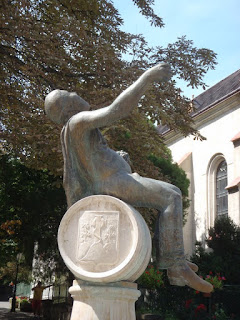
Statue of Bacchus Outside Racozi Pince

Tokaj (toke-eye, or toe-coy as some of the locals pronounce it)is world famous for its wines…its white wines.  Starting in the 17th century, the Hungarian king laid down restrictions stating that only wines made in this small region and only those made with one or more of six grape varietals could bear the name Tokaj.  This effectively made Tokaj the first “closed” wine region in the world; well before Bordeaux or Champagne.  Tokaj’s most famous wine is the aszú (a-zoo).  Aszú is essentially made from rotten grapes.  The grapes grow very large, but then the so-called “noble rot” sets in and cracks the skin of the grape, exposing it to the harsh sun.  These cracks coupled with exposure to the sun removes all of the moisture from the grapes, concentrating the sugar.  The aszú grapes are then picked by hand, one-by-one, and used to create the wine by the same name.  After tasting aszú wine, Louis XIV famously stated that it was “The wine of kings, and the king of wines.”  The wines we tasted definitely live up to their reputation.

What should have been a simple trip to relax and drink wine, once again, turned into quite an ordeal.  These difficulties have really been the overarching theme of our tenure in Hungary.  Luckily, we ran into a few very nice people over the course of the day that really helped us out.  We booked our train from Miskolc to Tokaj early Friday morning without issue.  Yet when we went to board the train, I wanted to make sure it was the right train so I checked with the conductor.  Good thing I did because he informed me that the Tokaj railway station wasn’t open!  They have been doing construction work on the railway just before Tokaj all week.  We would pick the one week that it’s nearly impossible to get to Tokaj.  Instead of just disembarking at the Tokaj train station, we were told that we had to get off the train at Szerencs and find a substitute bus that would take us the rest of the way to Tokaj.

Enter helpful stranger.  When we boarded the train there had been a middle-aged man sleeping in the seats across the aisle from ours.  After hearing my clumsy exchange with the conductor, he revealed to us that he spoke very good English, and even better, he was en route to Tokaj as well.  We later learned that he was a writer headed to Tokaj for a Hungarian writer’s conference.  Yet most interestingly, he was born in a Yugoslavian village, somewhere in modern-day Serbia, that doesn’t exist anymore.  He said that where he was from was a purely Hungarian village and that when the [Yugoslavian] war started and the minorities were being exterminated, he was 19 and fled to Budapest, where he’s been ever since.  We never caught the man’s name, so I’ll just call him Writer.
                Without Writer our trip to Tokaj would not have been nearly as smooth.  He helped us find the right bus outside of the train station, but he helped us even more later on.  Not 15 minutes into the bus ride, the bus stopped in the middle of an intersection.  It had broken down.  Just our luck.  Writer, told us to get out of the bus and had called one of his friends who was on his way to pick him up and take him to Tokaj, he said that we could tag along.  Yet before his friend arrived, a replacement bus showed up, so we hopped on that instead and finished our journey to Tokaj.

We checked into our hotel, which looked very similar to a seedy-roadside motel somewhere in the Midwest.  Yet it was sufficient, and cheap.  Then we set out onto the town, grabbed a pizza for lunch, and went to our first Pince (Wine cellar).  The Racozi Pince is the oldest cellar in the region, dating back well over 400 years.  We took a tour of the cellar, which was really cool, and then tasted six of the regions wines: two dry whites, three sweet whites, and the aszú.  The aszú is graded on a 1-6 scale based on the number of puttonyos used to create it.  A Puttonyo is a barrel (25 kg) of aszú berries.  In creating the wine, the same amount of grape juice is always used, yet the differences arise from the number of puttonyos added to that grape juice, with 6 being the best.  The aszú we had at Racozi was a 5 puttonyos aszú.  It was pretty good, but we had already tasted a 5 puttonyos aszú in Budapest that was far better.

After the Racozi cellar, we went to the Tokaj museum, which was an absolute waste of time.  After a quick power-nap, we trekked out past the railroad station to the vineyards themselves to walk around.  Seeing all of the fields of grapes covering the hillsides was pretty spectacular.

Upon returning to the city intent on tasting more wines, we were quite distraught to find that, although all of the signs in the city state that things are open until 20:00, all of the cellars close at 4:30!  It was just after 4:30 resumed our quest for wine.  Yet we lucked out once again.  We walked into the Hímesudvar Pincészet and the vintner told us that typically he would love to give us a tasting, but he had a meeting with the owner, who happened to be a very nice English lady.  Yet, he put a call down to one of his friends who runs the Sauska Pince and said that she would let us taste wine there.

We found Sauska, but from the outside it looked just as closed as any of the other cellars.  Yet Kati pushed open the large double-doors and we timidly walked into an empty marbled room.  We found a young lady in an office and she said they were closed, but she was allowing us to attend a private tasting with two of her guests that would be done in English.  Her guests turned out to be a gay couple from Poland.  The first man we met, a physician, was very nice and very friendly.  But his partner did not seem happy about anything and refused to speak in anything but Polish.  Yet the three of us had a great time.  The Polish couple were clearly wine connosiers and even knew the last manager of the winery we were tasting.  We had six wines, the last of which was the much coveted 6 puttonyos aszú.  It was worth the wait.  It was fantastic, yet Kati and I both agreed that the aszú wine we had in Budapest was far superior.  When we get back to Budapest we’re going to have to find the name of the winery that made it.  Apparently the Polish guys and the Hungarian woman thought it was pretty humorous that we were staying at the Hotel Tokaj.  Each time I told them where we were staying they gave me this look and said, "Oh...that's a nice place."  But they all seemed very amused when I responded, "I don't care where we sleep as long as we have great wine to drink."

After the wine tasting we also had a very intriguing discussion about the Hungarian language.  As I’ve stated earlier, Hungarian is unique in Europe and unrelated to any surrounding languages.  Linguistically, its closest relative is Finnish.  The Polish physician agreed with me on this point, yet our host told us that she couldn’t understand any Finnish.  She also told us that there has been a lot of modern research as to the origins of Hungarian and many now dispute that Hungarian is similar to Finnish at all.  While the dinosaurs in the field still adhere to that belief, she said that she does a lot of research on the topic and she, along with many more modern scholars, are convinced that Hungarian originated from the Asian languages; specifically from a precursor to Japanese.  Overall, despite the traveling issues, it was a great, and informative, day.

Miskolc - The Kandia Alley Bridge

Our Lock (We Had to Scratch a "J+K"
in with a Key)
They say there are places that can do magic to people.  The small bridge leading from Kandia alley to Szinva terrace is one of those places.

On a summer evening when this place was opened for the town's inhabitants, a boy and a girl walked over the bridge.  They were both very young and deep in love.  Holding hands, they stared at the water of the Szinva, gleaming in the darkness, and listened to the soft music of the gurgling river flowing by.  The boy wanted to speak about his feelings but was too timid and shy to say a word.  And the girl was just standing there hoping to hear the confession of love.  Girls have always been like this: since the beginning of time, they have always wanted to hear and not only feel that they are loved.  In a trembling voice, the boy whispered to her, "I love you."  His words were echoed by all the tiny drops of water in the river, murmuring the wonderful lines of the famous poem by Attilla Jozsef:


I love you as a mother loves her child,
As silent caves love their depth.
I love you as halls love light
As the soul loves flame and the body loves calm... 
They were standing enchanted on the small bridge, leaving time, space and reality behind, and listened to the river reciting the lines of the poem.  Perhaps it was only an illusion, perhaps it was the magic of love, but the River Szinva was softly murmuring the lines of Attila Jozsef's immortal Ode, the poem which was born in the same place as the river itself: in Lillafured.  It was on the little bridge in Kandina alley that the two youngsters first kissed and vowed to love each other forever because all lovers are insatiable; they are not satisfied by the eternity of the moment, but long for the infinite too.

The next day they returned to the bridge, tied two small padlocks together and fastened them onto hte iron rail.  They threw the two small keys into the water so that the padlocks that were to symbolize their never-ending love could not be opened and separated by anyone, not even by themselves.

Miskolc – The Legend of the Palace of Music

The Palace of Music
The following is one of the legends we heard that both of us liked a lot:

"Around where the Palace of Music now stands there used to be one-story buildings.  If people opened their windows they could see the Szinva river, as it flowed uncovered at that time.  There was a small park next to it, perhaps where the present building is located.  There lived a young man at that time who everybody called the “invisible violin-player.”  He lived like the birds of the night: he hid from people during the daytime.

He was an unfortunate child.  His parents and brothers died in an inferno, something which happened quite often then.  Miraculously, he survived, but his face and body were seriously burned.  They say that only his hands survived completely.  The old doctor who cured him grew very fond of him, so he decided to raise him and teach him how to play the violin.  When the old doctor died the only thing the boy had left was his violin.  He could play it in such a way that it broke the heart of anyone who heard it.  In the evenings when the sun set over the small houses, people would sit out and listen to him playing.  At such times, the men kept quiet, the women stopped gossiping, and the mysterious celebration took over them as their souls disappeared into the depths.

They say there lived a girl nearby who fell in love with the invisible violinist.  Or maybe it was the music that she fell in love with.  It felt like someone touching her heart with her bare hands.  It felt like someone had opened a door leading to her soul and found new places and kept opening new doors inside her.

Love has power as great as music.  One night this great power led the girl to the invisible violinist.  She crept up behind him quietly, covered his eyes and turned his face around.  The violin stopped and fell out of his hand.  It was a full moon that night and it shone down on them.  Only the moon saw the girl and the violinist looking into each other’s eyes.  The girl gazed at the face that was burned and deformed and the violinist was surprised to see the pair of dark blue eyes staring back at him.

They say that the girl’s family never forgave her for loving the burned-faced violinist.  They say that she was forced to marry someone else.  She didn’t have a chance.  In order to prevent her from escaping to see the violinist her father locked her in her room.  But love cannot be kept in a prison.  When the sun set the violinist started playing and told the girl that love is eternal.  The strings shivered from pain, hope and happiness.

They say it was already winter when they heard the sound of the violin for the last time.  The sound of the violin went through everything: the thick walls, the closed windows, and sad souls…

Some late-night passers-by saw two figures standing on the banks of the river.  The silhouette of a girl standing still and a man playing the violin.  They saw the man put his violin on a bench and hug the girl.  But the strangest thing was that the music never stopped.  It kept playing as if a hand from the sky had taken control of the violin.  The music flew in the air loud and clear.  The strings of the violin sang every happiness and pain of human fate.  No one had heard such a beautiful sound before.

Some time around midnight it started snowing and snow covered the trees, all the bushes, and the houses.  By dawn the music had stopped, and the girl and the violinist disappeared and nobody saw them ever again.  There were no footsteps left in the clear white snow.  The violin was found on the ground after the snow had melted.  They say that as soon as someone touched it the strings snapped quietly, just like a person’s heart breaks.

Many, many years later in 1927 the town built a Neo-Baroque style palace there.  A building that is worthy of the legend connected to it.  Since then everything is pure music there.  That is what the lute on the front of the building, the square in front named for Béla Bartók and the statue of the boy playing the flute all represent.  The rails of the balcony, the door, the windows and stairs are all musical notes carved into iron.  The wall paintings in the concert hall also stand for this.  Everything is completely about music here even when the hall is quiet, when there are no concerts, when the sound of the pupils’ instruments are not heard on the street.
How odd, how great, that so many famous violin players are somehow connected to Miskolc.  Ede Reményi, the bronze relief of Ernó Lányi near the staircase, the statue of Jenö Hubay in the front room of the concert hall, they all remind the visitor of them.


The three of them were world famous, the whole world could hear them play.  The memory of the fourth one, the invisible violinist, is not preserved by any statue or memorial.  Only this legend is left.  But legends live forever, just like love and music."

Miskolc - A Day of Actual Exploring

Timber Church
Our second day in Miskolc was jam-packed with things to do.  We started the morning bright and early with a hot breakfast at the hotel.  Unfortunately the Hungarians’ idea of eggs and sausage consisted of very runny scrambled eggs and a microwaved hot dog.  We opted to stick with cold meats, yogurt, and cheese.

After breakfast we made the trek down to the bus station in Miskolc-Tapolca to head out to Diósgyör and the medieval castle.  It was clearly a haven for young children, but cool nonetheless.  Interestingly enough, the castle is where the Peace of Turin was signed to end the war between Venice and Hungary.  The castle is also home to the largest set of wax figures in Central Europe.  They were really poorly made and pretty creepy, but it was still kind of neat.  I felt really bad for our tour guide who was kind enough to ask us if we were American and then proceeded to painfully give the tour to us in English (And Hungarian for everyone else).

We spent the afternoon back in central Miskolc.  The kind ladies at the TourInform center gave us a pamphlet with walking tours of downtown Miskolc that would take us past all of the major sights in the city.  We opted to take the long tour and see everything.  The booklet was interesting in that it didn’t provide you with dry facts about everything in the city.  Instead, it stated upfront that the best way to get a feel for the city is to see the sights and hear the legends/stories behind each location.  If I have some time, I’ll post some of those later.  The walking tour was fun, but somewhat disappointing because for some inexplicable reason all of the churches and the synagogue were closed all afternoon on a Thursday.  It just doesn’t make sense.  There were no signs with posted hours for the churches, they just seemed to be closed all the time.  My favorite sight in the city was hands down the Timber Church, unique in that it is made entirely of wood.  Unsurprisingly, the current church is the fourth reincarnation on the same sight; the previous three having fallen victim to “infernos.”

It was a long day and we were both exhausted.  Kati had decided to wear a strapless dress all day yet neglected to put on sunscreen, so by the end of the day she was pretty burnt.  By the time we made it back to the hotel in Miskolc-Tapolca, it was around 5:00 and we were beat.  Yet, seeing as there was no food in the immediate vicinity, we knew we had to venture out at least one more time that evening.  We mustered up our strength, grabbed our towels, and headed back down to the cave baths to relax before grabbing dinner.  It was an excellent choice.  The thermal mineral water and the “healing” air in the cave really rejuvenated us…at least long enough to have dinner and hike back up the hill to our hotel.

Hungarian Frustration

“Reservation!”  That’s the only word I could comprehend.  It’s the only word that held any meaning; any value.  Not an hour into a mid-morning train ride across the Hungarian countryside from Budapest to Miskolc, I had a run-in with a Hungarian train conductor.  It’s in these routine, common-place interactions where communication is most taken for granted and yet effective communication is most important.  This is by no means a tale of effective communication.

*********************************

The night before our departure for Miskolc, I was already feeling a bit uneasy about the trip.  The language barrier in Hungary had already proven more substantial than any I had encountered before.  While I had managed to make due up until that point in the trip, moving from the cosmopolitan metropolis of Budapest to Miskolc, a non-tourist destination, raised deeper concerns about the extent to which the language barrier would be amplified.

My perception of Hungarian as an impenetrable language could be due to the fact that those Hungarians around Budapest seem to mumble and slur words together so much that it sounds like incomprehensible gibberish instead of distinct words and phrases.  However, more likely than not the language’s impenetrable nature has to do with the fact that nobody understands how it originated or from where it was derived.  Thus it is different from anything you will ever hear or encounter elsewhere.  It is unique in that it bears no resemblance to any other language in the area and it closest linguistic relative is, strangely enough, Finnish.  They say that Hungarian is the most difficult language in the world to learn, and, after this trip, I can attest to the truth of that statement.

*********************************

When the morning of our departure arrived, I had begun to feel more confident about the likely success of our trip.  A hot shower and a good night’s sleep had rejuvenated me and restored my confidence.  The morning started like any other.  It had become routine by now.   First, I load my clothes into my stuff sack and compress them down, tightening each strap in turn to minimize space.  The clothes go into the pack first—the need to access them while in-transit is minimal.  Next, my raincoat and jacket go into the bottom pocket for easy access.  Then, all of my electronics and books are placed in my day pack and it’s jammed into the remaining space near the top of my backpack.  After pulling up my socks and tying my shoes, I throw the backpack over my shoulders, buckle all of the straps, and I’m ready to go.

We made it to the train station just in time, and after a successful bilingual exchange with the lady at the ticket counter, we had two tickets to Miskolc in our hands and were ready to go.  The train was no different from any other we had been on in Europe.  We skipped the first class car and went straight to second class—we had made the mistake of sitting first-class in the Czech Republic, but the kind conductor informed us we were in the wrong car and pointed us in the right direction.  We easily found two open seats in a nearly empty train and sat down to the breakfast we had picked up along the way.

About 20 minutes into the trip, the conductor came around to check tickets.  I’d been through this process so many times, in so many languages, that I wasn’t concerned.  I’d mastered the simple art of handing my ticket to the conductor and taking it back after he confirms its validity.  Yet this time was different.  It wasn’t quite so simple.  I always held onto the tickets for both Kati and myself.  I handed both tickets to the conductor and he seemed to approve and handed them back to me.  Then he approached Kati clearly seeking her ticket.  In an attempt to head off any encounter between the two, I kindly gave him the tickets back, pointing to the tickets and then pointing to Kati and myself, indicating that my tickets were for both of us.  It was then that everything went wrong.  For some reason, having two tickets was sufficient for my trip, but insufficient to cover both of us.  Then he spoke the only word I understood: “Reservation.”  “These seats are reserved?” I asked.  He nodded his head in apparent understanding.  I pointed to our tickets and toward the car immediately behind us.  He was unphased.  No response.  I pointed to the car immediately in front of us.  “Reserved?” I asked.  No response.  No nod.

My Hungarian is limited to a few choice expressions I have written down in a little black, leather-bound book I carry with me everywhere.  My first instinct was to try to use signs to ask if we were in the wrong seats and, if so, where we were permitted to sit by our tickets.  My efforts were to no avail.  The only result was that he reached into his fanny-pack and pulled out a small computer, reading “720 HUF”—720 Hungarian forints, equivalent to just under $4.  Again, I attempted to use signs coupled with English to convey my point.  I could see the ivory glaze roll over his eyes.  It was clear that we were from two vastly different floors of the Tower of Babel.

I made the first attempt to breach the language barrier by grabbing my trusty black book.  Quickly flipping to the page of Hungarian phrases I’d jotted down, I found what I was looking for.  I kindly looked at the man, pointed to the tickets in his hand and asked, “Hol?”  “Where?”  He chuckled, and just pointed again at the digital display reading “720 HUF.”  By this point I was frustrated…exasperated, and the conductor was growing increasingly and visibly annoyed.  To head off any further and more severe confrontation, I paid him the 720 forints he was demanding and resolved to stew in my own annoyance.  In return for my payment, I received a small receipt.  It contained no seat numbers, no “reservation” and no identifiable information other than the clear and distinct fact that I paid “720 HUF.”

Thursday, August 11, 2011

Cave Baths!

Today I learned an important lesson: Trust yourself.  I've spent years planning every detail of this trip; researching every minor point.  Yet there are still a couple areas that worried me due to a lack of reliable information.  Miskloc was one of those areas.  It's the third largest city in Hungary but for some reason isn't in any American Guidebooks.  Everything in our trip (Save our Hungarian overture) has gone relatively smoothy, yet for some reason the night before departing for Miskolc I lost my composure and became convinced that everything would go wrong on our trip.  It's very difficult to find lodging in the city and everything in the city is very spread out.  Thankfully, Kati stepped up and set up a contingency plan that really helped calm my nerves because none of the hotels I had contacted had responded by the time we had to leave.

Before discussing our day, it may be helpful to explain how Miskolc is laid out.  The area and its attractions are kind of arranged the shape of an "L" on its side.  Miskolc's downtown is found at the juncture.  Miskolc-Tapolca is about 20 minutes south of Miskolc.  Diosgyor is about 15 minutes west of Miskolc and Lillafured is another 15-20 minutes west of Diosgyor.

The Cave Baths
From the train station, we immediately followed Kati's (comprehensive and easy) plan and found ourselves at a "hotel" on Miskolc University's campus.  They had cheap and available rooms, yet we quickly realized that we were in the middle of nowhere and there was no food around (Yes, college campus and no food...what's up with that?).  Interestingly enough, the hotel was housing all of the young ladies from the FIBA basketball championship.  Yet to quell my complete and total unease with the situation we decided to make the trek to the center of the city To the Tourist Information Center and planned to find a hotel downtown.  Yet upon reaching the tourist information center we decided it would be more efficient to stay in Miskolc-Tapolca, near the cave baths.  Finding a place to stay was more problematic than anticipated.  One of the kind ladies at the center called a long list of hotels in the Tapolca area, only to find that 99% of them were completely booked.  Luckily, we found one with a free room that wasn't too much out of our price range.  Then we threw our packs back on to make the trek south of the city center.  Here's where my lesson of the day comes in: If we had followed my original plan, and if I hadn't freaked out about the trip the night before, we would headed directly to where we ended up after all of our unnecessary traveling.  Oh well, you live and you learn.

Our hotel was about 850 meters from the bus stop...uphill.  By the time we finally got there both of us were exhausted and our spirits were all but crushed.  We had arrived in Miskolc at 10:30 but by the time we checked into our hotel it was past 3:30.  Yet we decided to stick to our plan and check out the cave baths that evening.

Kati and Me at the Cave Baths
Miskolc-Tapolca is "famous" for being the only spa/bath in the world that is located in a natural cave system.  It is SO COOL!  There are a number of outdoor and indoor normal pools, but the focus of the area is on the five thermal baths that wind their way through caves.  The temperature of the water in the baths ranges from lukewarm to slightly warmer (Unfortunately no hot-tub temperatures) but there are saunas in the caves as well.  The first bath is kind of like a lazy river winding through cavernous halls.  The second has all sorts of water spouts crashing down through hollow cave formations.  Yet the best one (and the warmest) has three areas: two are relatively typical, but warmer than the others yet the third is a completely rounded dome room, painted black with constellations on it and anything that anyone says within the room echoes.  I really can't overstate how cool these baths were.  We were swimming...in a cave!  As we sat there, soaking in the water; massaging our feet with jets, all of the stress from the trip and the day just fell away and we both agreed that all of the suffering and misery from the earlier 3/4 of the day was totally worth it.

Wednesday, August 10, 2011

Esztergom - What a Church!

The Basilica From the Front
 August 9 - Today our travels led us off the beaten path to the unique city of Esztergom.  The town itself is to the Northeast of Budapest and takes about 90 minutes by train.

The city itself is deceptively historic and surprisingly unknown to tourists.  It was here, near the banks of the Danube, that Marcus Aurelius penned his famous Meditations.  The city also has great significance to the Hungarians as it was the birthplace of Saint Stephen was and the location of his coronation as the first king of Hungary (.  The main (and nearly only) attraction in the city is the massive Esztergom Basilica, the largest church in Hungary.  It also holds the honors as being the tallest building of any kind in Hungary and the 18th largest church in the world.

Statue of St. Stephen's Coronation
Our tenure in Esztergom started at the train station, well outside of town.  On the walk toward the basilica, we found ourselves in the true Hungarian countryside.  Kati hasn't been able to recall much of her previous visit here, but she said that walking from the train station looked a lot like the way she remembered Hungary when she was a child.  It was quite a walk.  It took us 20 minutes just to get into "town."  The basilica is built upon a large cliff, and we had difficulty figuring out which way to head up the hill, so we opted to walk along the Little Danube (small off-shoot from the Danube) along a quaint shaded sidewalk in a very residential part of town.  We quickly found we were on the wrong side of the basilica--looking straight up the cliff at the back of the building.  However, we stumbled upon signs for the "catwalk" which turned out to be a back-alley, marked by a grate depicting cats.  This alley led to stairs that wound their way up the face of the cliff to the back of the basilica.  The climb was nice and the views were stunning.

At the top, we took a break to take in the panoramic views.  Esztergom is right on the border between Hungary and Slovakia.  The bank right across the Danube marked the start of Slovakia.  If we had more time, we could have walked there!  But we were there for the basilica.  The basilica is unbelievable inside.  The dome peaks at 76 meters (249 feet) tall.  It was decorated a little more simplistically than some of the other churches we've seen, but that just added to its magnanimous beauty.

We also bought tickets to see the Treasury, the Cupola (Dome), and the Crypt.  The treasury was pretty neat.  As you would expect, it contained an inordinate number of priceless religious artifacts: crosses, chalices, relics, and ornate religious garb.

The crypt famously contains the remains of the controversial Cardinal Mindszenty, who refused to allow Hungary's Catholic schools to be secularized.  Mindszenty was a strong critic of the Vatican's relations with the communist regime in Hungary.  He eventually left for Vienna, vowing that he would not return to his homeland until the last Soviet soldier left Hungarian soil.  He died in Vienna in 1975 but his remains were not returned until May 1991, ironically two weeks before the last Soviet soldier departed from Hungarian soil.

Our last stop before leaving the Basilica was the dome.  I hadn't realized you could go up in the dome until we had already bought tickets that included it, but I was really excited.  We started climbing a spiral staircase that couldn't have been any more narrow.  It tightly wound up...and up...and up.  We got to a nice, stable, steel viewing platform that wrapped around the dome and I was thrilled we had made it.  But Kati, much to her chagrin, pointed out that we could go higher still.  Again we found ourselves in a ridiculously tightly-wound spiral staircase that seemed to never end.  Kati, starting to worry asked me if it was much further.  I probably shouldn't have said, "Well, we are climbing almost an entire football field up, so a ways."  Yet she did great during the ascent.  When we reached the top we found ourselves literally 15 feet from the tip of the dome on a make-shift wooden platform that wound around the entire dome.  Only small steel rails separated us from a quick slide down.  When the wind started blowing it was more than a little unnerving even for me, but surprisingly Kati seemed more comfortable up there than I felt.  Yet it was totally worth it.  The views were breathtaking.  Check out some of my panoramic shots from the top in our album.  It was an unbelievable day.

Tuesday, August 9, 2011

Exploring Budapest

Yesterday was our first "real" day in Hungary.  We spent it taking in the sights that Budapest has to offer.  I was crazy-excited about checking out the city seeing as the Hungarian Parliament is one of my favorite buildings in the entire world.  Our plan was to wake up early and take the city by storm and that's exactly what we did.

Luckily, we snagged tickets to the Parliament tour early in the morning before the line got too long.  The way they run the sale of these tickets is absurd.  There's a big "buffer" of chains and fences around the Parliament but you have to go inside to buy tickets.  The problem is that in order to go inside to buy tickets, a guard has to let you in and he refuses to let in more than 1 (or 2 people max) at the same time.  So he lets you in, you walk all the way to the Parliament, buy your ticket, then walk all the way out, and when you cross his little chain gate, he lets the next person in.  By the time our tour time rolled around (11:45) the line was absolutely ridiculous.  Yet the building was stunning inside!

Between buying our tickets and our tour time, we decided to try and check out a few other sights.  The Basilica of St. Steven was pretty neat.  It holds Hungary's holiest religious relic: the mummified hand of St. Steven, the first king of Hungary.  It's a pretty morbid exhibit, but neat nonetheless.  Our next stop was at the Museum of Ethnography.  It was here that we learned our first unfortunate lesson about Hungarians--apparently they have a strong aversion to work.  We never got to see the Ethnography Museum (or later the Terror House) because for some inexplicable reason about 50% of the tourist attractions are closed on Monday!  Not only that, through my research I found that in the off-season, a lot of tourist attractions are closed on both Monday and Tuesday!  I wish I had a job that I didn't have to work Monday or Tuesday and that I didn't have to start until 9 or 10 every other day.  Hopefully we'll get to see all of the closed places when we come back on Saturday.

The rest of the day was spent seeing all of the other sights.  We toured the Opera House, which was beautiful.  Apparently it has the third-best acoustics in the world...of course the first is La Scala in Milan, and let me tell you, they really are that good in there!  We also stopped by the Castle, which is really bizarre.  It was made for some sort of fair held in Budapest and the architect sought to showcase every Hungarian style, so he included Classical, Baroque, and Gothic buildings in the same complex.  It was supposed to have been torn down right after the fair, but everybody loved it so they kept it around.  The complex is neat, but so stylistically disjointed that it's kind of crazy.

I do have to say, the highlight of my day (and I'm confident Kati would agree) was the Royal Wine Cellar.  This place is tucked away in a corner street and you would never find it unless you knew it was there.  It's located where the wine cellar for the Royal Palace used to be and they have a "museum" and do tastings of Hungarian wines.  The museum was interesting in that it was situated in all of the old cellar tunnels which was really cool, and while it was neat to learn about all of the wine regions in Hungary, overall I found the museum lacking in substance.  Luckily, we didn't pay for the museum...because we bought the top-flight wine tasting.  It was totally worth it!  We tasted six Hungarian wines: 2 whites, 1 rose, 2 reds, and 1 tokaj azsu (dessert wine).  They were hands-down, some of the best wines I've had in a long time and our sommelier was fantastic.  We were definitely on the same wavelength because he brought out everything I'd wanted to taste.  The first white was a Sauvignon Blanc followed by a very unique Hungarian white called Jukfurt.  Then we had a dry Pinot Noir rose followed by a red wine from Eger (Not Bull's Blood) and a very spicy red wine from the southern part of the country.  The Tokaj wine was out of this world.  It's one of the best wines made in the region, but we'll be there in a few days so I won't belabor it's glory now.  When we told our sommelier that we were going to Tokaj this week to taste wines he even went out of his way to find the addresses for two vineyards he specially recommended.  It was so much fun!

We finished off the night with dinner on Castle Hill before calling it quits for the evening.  The morning held another day-trip to Esztergom, home of the largest church in Hungary.

Monday, August 8, 2011

Szar Napom Van!

Fisherman's Bastion on Castle Hill in Buda
Over the course of our Czech adventures, we never had a downright horrible day.  Sometimes our plans derailed a little bit or there was our day of rain in Karlovy Vary, but never a day that made me want to scream.  Then we arrived in Hungary.

The train from Prague to Hungary took just under 7 hours.  I was really worried about catching it because we were running late, but everything worked out fine.  First half of the trip went off without incident.  Then in Brno, Germany these 10 English kids that had just "completed University" got on the train.  Nine of them were easily the most obnoxious people we've run into in our travels.  Their plan was clearly to get drunk, loud and obnoxious the whole way to Budapest.  It really was our lucky day because they were partying in the cabin right next to ours and we could hear every word that they said.  We felt really bad for the tenth English guy because he sat in our cabin and just looked unhappy with the rest of them and the whole situation.  Not only did he clearly not want to partake in the festivities, he had to guide all of his drunk friends around Budapest that night.  I don't know why Americans have such a bad reputation in Europe when the English are just as bad, if not worse--because they're in Europe in greater numbers and more often.  Yet if obnoxious Brits was the only problem with our day, I could have managed.

The real trouble started when we boarded the metro.  Using my trusty guidebook, I purchased us each "short" tickets.  My guidebook assured me that the short ticket was valid for 30 minutes as long as you don't transfer trains (Which we weren't).  There was a more expensive ticket, actually called a transfer ticket, which neither my guidebook, nor myself thought we needed.  I couldn't have been more wrong.  We took the M2 five stops from the train station to our hostel.  Upon surfacing in Batthyany ter, we were confronted by the HEV ticket patrol.  With their unwarranted level of intensity, they might as well have been the Allamedelmi Osztaly (The Hungarian Secret Police).  They took our tickets and immediately ushered us over to the side and started spouting off way too much Hungarian for either of us to follow.  I tried to explain to them that I had asked the ticket man what ticket we needed and he gave us these short-term tickets.  They pointed me to some fine print on the back of the tickets that stated they were only good for three stops...we had gone five.  We apologized profusely, but it was to no avail.  We were "spot fined" 6,000 forints each for being in violation.  It's a good thing I had just stopped at an ATM because if you can't pay the spot fine, you have to pay 12,000 forints per violation.  Needless to say, I was pissed.  Not only did I have to shell out almost $65 for our two violations, it used up so much of my cash that I didn't have nearly enough to pay the hostel and had to withdraw money from the ATM again, not 15 minutes after my first withdrawal!

Still fuming from the metro incident, we made it to the hostel.  Our hostel was cheap as dirt (<$10/night) and we definitely got what we paid for.  It's essentially Hungarian college dorms.  It was upon our arrival that I was told the hostel would not accept credit cards.  We threw our backpacks in a locker in our soon-to-be room and struck out to find an ATM.  Upon our triumphant return to the hostel, loaded with 10,000 forint notes, we paid and then went to open the door to our room.  It was locked.  There was no key.  Each room only has one key and someone else in our room, against strict orders from the hostel staff, took the key out on the city with them.  Our packs were locked up and we couldn't get to our beds.  We said, "No problem, we'll just go out and get some dinner."  After dinner, we returned to the hostel only to find that the room was still locked.  With increasing frustration we climbed up a nearby staircase to the top of Castle Hill to waste some time.  We saw the beautiful Matthias Church, took in views of the Danube from the Fisherman's Bastion, and went on an unsuccessful search for a sidewalk shop that would sell me a bottle of water.

We walked back down the hill about an hour and a half later with low spirits and lower hopes that our room would be open.  I was sure the two guys that took the key had left for the night and we would be without anything for the entire evening.  So much for our restful night of relaxing and planning our next steps.  Luckily, our room was unlocked and we discovered it was two bloody English pricks that stole the key for the last almost four hours.  Relieved to have our stuff and our beds, we retired for the night.

In hopes of not ending a post on such a negative note, the Parliament building is absolutely stunning and we're very excited about touring the city tomorrow.  Hopefully we've gotten all of our bad luck for Hungary out of the way and the rest of the trip will run smoothly.