Showing posts with label Ireland. Show all posts

Sunday, July 23, 2023

Slán Leat Sult!

July 23, 2023

It was our last day and we had one final breakfast out on the covered porch before saying our goodbyes, packing our bags, and heading to the airport.  Ireland decided to mourn our departure with even more torrential rain.  Our cab driver was an interesting lady who gave us lots of good advice about the Dublin airport that we promptly learned was totally false.  I resisted the urge to buy more liquor to take home with me at the duty free store and our flight home was uneventful...until we reached Charlotte.

It turns out that we brought the Irish rains with us and, when we got to Charlotte, it was embroiled in a terrible rain storm.  The storm was so bad that we had to circle the airport a few times before being cleared to land.  Even then, there was significant turbulence and, at times, the plane felt like it was going to roll over while we were slowing down on the runway.  It was definitely one of the worst landings I've experienced.  The issues continued to come once we landed, on time, mind you.  First, we sat on the tarmac for an hour because the rain was so bad that they had to close the ramps.  Then, we went to the madhouse that was baggage claim.  It was packed and total chaos.  our flight wasn't on the baggage claim board and nobody could tell us what was happening.  When we finally got a carousel, maybe 25% of the bags from our flight came out.  We got one of ours, and then the conveyor belt stopped.  When it started back up, it was for totally different flights!  the bags from Dublin didn't start appearing again until an hour later!  It was a complete disaster.  If it's possible, the arrivals deck was even worse.  Tons of cars were just stopped and blocking movement, but none of the traffic personnel were doing anything about it.  We touched down around 2:00, but didn't get out of the airport until after 5:30.  I've been dealing with construction at the Charlotte-Douglas Airport for years, and there are times where it's been bad, but this was by far the worst experience I have ever had.  Despite the painful ending on this side of the pond, it really was an unbelievable trip!

Saturday, July 22, 2023

The Great Dublin Tour

July 22, 2023

Our last day in Ireland was spent exploring Dublin.  We started with our traditional, laid-back, breakfast at the hotel...at least Tyler and I did.  Morgan and Kati decided to forego breakfast in favor of sleep.

The first stop on our great Dublin tour was Trinity College.  Established in 1592, it is Ireland's oldest and most prestigious college and has produced notable graduates including Jonathan Swift, Bram Stoker, Oscar Wilde, and Samuel Beckett.  We met our tour guide under the iconic Campanile.  She was a rising second year had the brightest eyes I think I've ever seen, and was overly enthusiastic about everything.  She began with a discussion of George Salmon's statue, which is not without controversy.  He was the provost 1888 and 1904 and, most notably, was adamantly opposed to admitting women to Trinity.  Our guide directly confronted this fact and why she (and many others) believe that retaining the statue in the middle of campus is important despite Salmon's discriminatory and antiquated views.  They view it as a monument and reminder of how far the college has come and what it has overcome in the name of progress.  The female students embrace the statue, frequently jumping in its arms and kissing it on the cheek for pictures after graduation.  It's a refreshing view of history that I think we could benefit from in the United States.

We saw some cool stuff across campus, including the Samuel Beckett Theater, but the most impressive was definitely the Museum Building.  Built between 1853 and 1857 in the Ruskinian Gothic style, it showcases 13 different types of Irish stones, including Connemara marble.  Found exclusively along Ireland's wild Atlantic coast, the green marble is one of 32 designated Heritage Stones in the world.  I've never seen anything quite like it.  The Museum Building is also home to two Irish elk skeletons, which was quite something to behold.

The campus tour was interesting, but the reason we did it was to gain admission to see Ireland's greatest cultural treasure: The Book of Kells.  Created in the 9th century, the Book of Kells is one of the finest and most famous of an illuminated manuscript in the Insular style.  It is thought to have been begun by Columba at the Abbey of Iona, until he had to flee from viking invaders, and brought the book to the Abbey of Kells where it was finished by others.  There are a lot of theories, legends, and debates regarding its creation and history, but its magnificence is beyond debate.  I've never seen anything quite like it and it blows my mind to think about how they could have created those intricate and vibrant images.  The exhibit was packed to the point of being frustrating and difficult to maneuver around, but it was worth it, even if we only got to see two pages of the book itself.

After passing by the Book of Kells, they send you up into the Long Room, which may be the most fantastic library I have ever seen. It's over 200 feet long and filled with more than 200,000 of the college's oldest books. It was built between 1712 and 1732, and since 1801, the library has been given the right to claim a free copy of every book published in Britain or Ireland! It also includes some extraneous treasures on display, like one of the few remaining copies of the 1916 Proclamation of the Irish Republic that was read outside the General Post Office on April 24, 1916 by Patrick Pearse at the start of the Easter Rising, and a harp from the 1400s (the oldest of its kind) that became the model for the emblem of Ireland. I was also very impressed by their forethought. Large swaths of the Long Room's shelves were barren of books because, following the fire at Notre Dame, the college determined that it also has a similar vulnerability so they are systematically removing books, cleaning them, and restoring them to prevent a similar disaster.

From Trinity College, we set out for lunch. I had heard that the Temple Bar Food Market is one of Dublin's oldest and longest running outdoor foot markets, so we were hoping to check it out. It purportedly runs every Saturday from 9:30-4:00, but we went straight to Meeting House Square and there was no market to be found. Frustrated and a little disappointed, we continued our walk and swung by the hotchpotch complex that is Dublin Castle. Originally built by King John in 1204, the castle was the stronghold of British power in Ireland for more than 700 years. Today, only the Record Tower survives from the original construction, with the rest having been built at various times from the 18th century on. We didn't go inside, but it was a bit surreal to see this bastion of brutality that served as the source of Britain's anti-IRA campaigns and to think that just over 100 years earlier, Michael Collins stood right where we were as the complex was ceremonially handed over to him and the newly formed Provisional Government of Ireland.

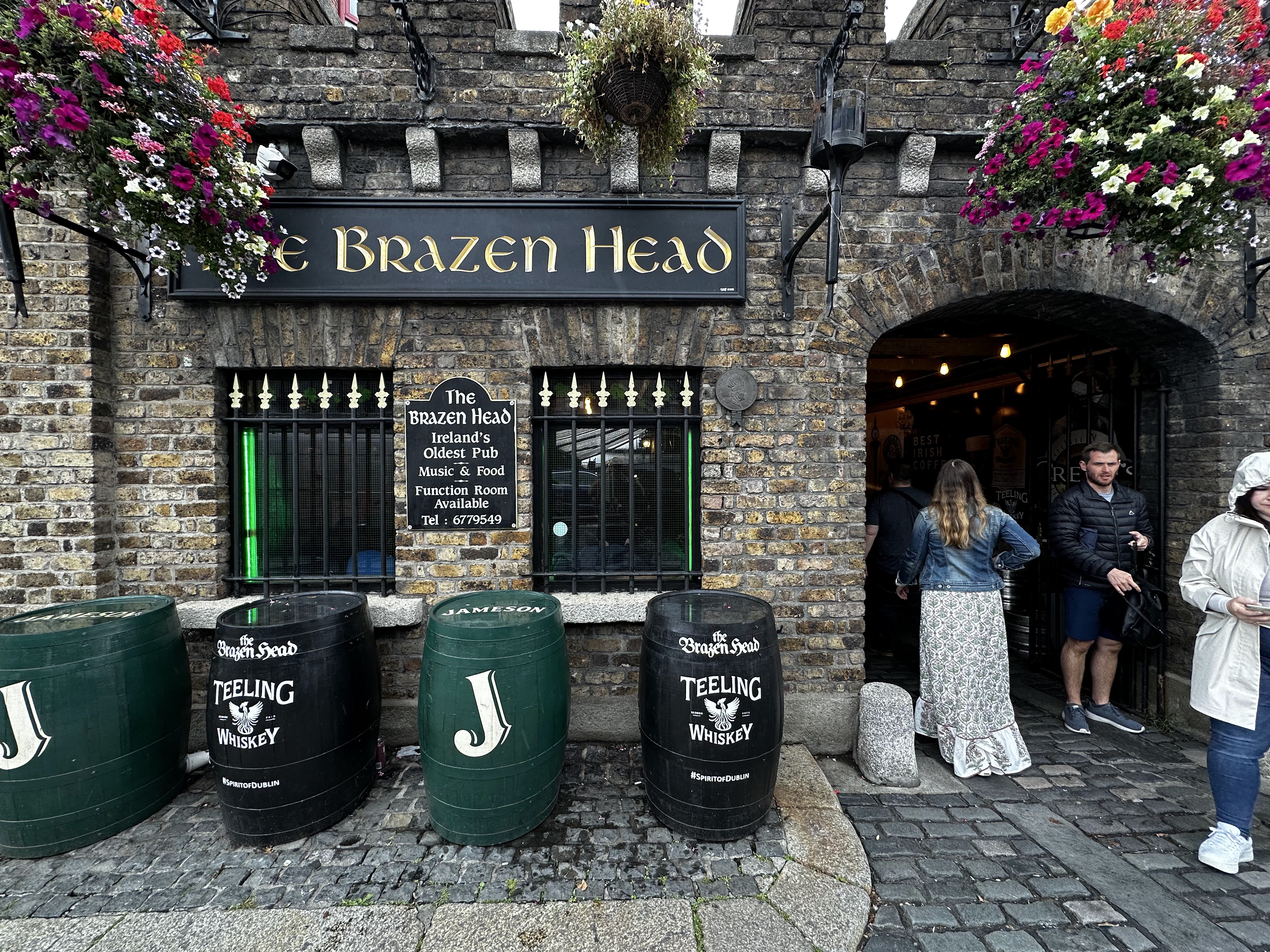
Ultimately, we found ourselves right by Darkey Kelly's and decided to stop in for a pint and some lunch because few other places were open at 11:30 am. The food hit the spot and then we were up and walking across town to the Jameson Distillery. On the way, we stopped in another pub for another pint. This one - the Brazen Head - is the oldest pub in Dublin, having been established as a hostelry in 1198. The Irish name for Dublin is Baile Átha Cliath, which means "the town of. the ford and the reed hurdles." It was so named because people used to cross the River Liffey at low tide using reed matting positioned on the river bed. The Brazen Head is located at the spot of that original river crossing! It was a really cool spot and humbling to think about all of the greats who used to frequent it. In fact, James Joyce liked it so much that it makes an appearance in his novel Ulysses.

Lucky for us, the Father Matthew Bridge spans the River Liffey now, so we didn't have to wait for low tide or use reed mats to cross it. The Jameson Distillery was cool, but didn't hold a candle to the Guinness Storehouse. The entire experience was just a little too on-the-nose of an ongoing advertisement, but it was still fun. The most interesting fact I learned on the tour was that in 2006, Jameson redesigned its crest following pressure from sailing enthusiasts. Apparently, they were bothered by the fact that Jameson's ship only had one large mainsail when it should have two. This discrepancy was unacceptable because, were they to create a life-size version of the ship from Jameson's crest, a two-sail design would be much superior to a one-sail design. Honestly, before I read that, I couldn't have told you that Jameson had a sailboat on its crest! I also learned that Jameson has started aging whiskey in old beer barrels and has an IPA cask version. That's the first time I think I've seen liquor aged in beer barrels and not the other way around. We also got to visit the maturation warehouse and drink whiskey pulled directly from the barrel, which was neat.

After Jameson, we walked back over the River Liffey and stopped in at Christ Church Cathedral, which was founded in 1030 under the Viking king Sitric Silkenbeard, and substantially rebuilt in 1172 under the the Norman potentate Strongbow. Interestingly, the church is officially claimed as the seat of both the Church of Ireland and the Roman Catholic Church in Ireland even though in law, and in fact, only the Church of Ireland has used it since the Irish Reformation. The church was beautiful, and the massive crypt underneath was interesting as well. I was most fascinated by these two broken swords displayed in the crypt. One sword is said to have been used by a young soldier accidentally locked in the crypt after the funeral of his commanding officer in 1822. After the funeral service had finished, the soldier lost his way in the warren of piled up coffins in the crypt and was devoured by rats. He was found some time afterwards, still grasping his sword. The weird part comes in the 1950s, when one of the cathedral vergers caught a boy running out of the grounds with a broken sword. He brought it back to the cathedral to hang it up in the Chapter House, where it was displayed, only to discover that the original sword was still in place. The mysterious appearance of the second, identical weapon has never been explained!

As cool as Christ Church was, we were all pretty spent and wanted to get back to the hotel for a quick respite. The walk was about 1.5 miles, but it felt like three times that far. We cut through parts of the city that we hadn't seen before and Kati questioned whether I knew where I was going several times, but we finally got there and took a load off for a few before heading back out.

In the time it took us to get ready for dinner, the sky opened up. It had rained literally every day of our trip, but this was the first time we had seen a torrential downpour. Though we were going to walk to our next destination, we opted for a taxi instead. Farrier & Draper, on South William Street, is probably the most unique and eclectic establishment we had stopped at on our trip. It takes up three floors of the Powerscourt Townhouse and each room is an experience in and of itself. We lucked out and got a table in the Gallery Room, which the hostess assured us was "the best room." It's hard to disagree with her as the extra-high ceilings, paintings from ceiling to floor, and colorful furniture were pretty stunning. On top of that, the cocktails were exquisite. Yet after two rounds, it was time for dinner.

We had saved a particularly special place for our last dinner. Mr. Fox is set in the basement of a gorgeous Georgian townhouse on Parnell Square, where they celebrate Irish ingredients with a cheeky twist. Though it doesn't have a Michelin star yet, many expect it to get one soon. We grabbed a taxi again because it was still raining hard. Along the way, I saw some unexpected graffiti on a transformer box: "I·R·A 20203 Derry." We had seen plenty of remnants of the IRA years in Northern Ireland, but this was the first time I saw something in the Republic of Ireland, and something that was current. I actually haven't been able to stop thinking about it and would love to understand the story behind it.

The food at Mr. Fox was unbelievable! Kati will adamantly disagree with me, but I preferred our meal at Mr. Fox to the one we had at Chapter One. We started with a trio of canapés - Osietra caviar and a chive flower on a deviled egg, a king crap, Yuzu Kosho, and fennel croustade, and a bluefin tuna and sriracha tartlet. All three were amazing. After whetting our appetites, they brought out a langoustine carpaccio, some halibut, and lamb with smoked ricotta, black garlic, and a stuffed zucchini flower. Then, they finished us off with four desserts. The star of the show was definitely their modern take on a peanut butter and jelly sandwich. I truly cannot begin to describe how incredible that little thing was! We couldn't have asked for a better last dinner on our trip and we savored every second of it. Somehow, the week had flown by but simultaneously felt like we had been there for a lifetime. Reluctantly, but filled to the brim with joy, we piled into the taxi and made our way back to Number 31 Leeson Close to pack our bags for the long journey home.

Friday, July 21, 2023

Passing Through the Boyne Valley

July 21, 2023

It was our second-to-last day in Ireland and we were doing one last day tour, this time up to County Meath to see Brú na Bóinne and the Hill of Tara.  Our tour was through Mary Gibbons, who was this delightfully small Irish lady who showed up like she was going on a safari.  Ultimately though, she didn't actually take us on the tour, leaving us instead with a guide whose name I can't remember, but whom I started calling Colm because his droning tone and propensity to go down tangents off of tangents was reminiscent of Uncle Colm in Derry Girls. Somehow he managed to fill up virtually every second of our hours on the bus with random stories and factoids, some of which were incredible, and some of which just lulled you to sleep.

Our first stop was Brú na Bóinne, which is one of the world's most important prehistoric sites. It contains three massive megalithic passage tombs and somewhere around 90 other monuments. The area has been a center for human settlements for at least 6,000 years and some of Neolithic mounds, chamber tombs, standing stones, henges, and other prehistoric enclosures date to as early as 3,500 BC, predating even Stonehenge and the Egyptian pyramids. The three most prominent of the passage graves at the site are Newgrange, Knowth, and Dowth. We were visiting the first two of these.

Our tour started at the visitor center, which was unbelievable. They spared no expense in developing this place and laying out an immersive experience to take you all the way back to the Neolithic period and understand the significance of the area. Then, we took a bus up to Knowth (Cnóbha). It is the largest of the mounds, at 40 feet high and 220 feet in diameter, and is surrounded by 17 smaller satellite tombs. It is dated to around 3,200 BC and contains two passages that run east-to-west and are thought to align with the equinoxes. The passages lead to separate burial chambers, with the eastern passage ends at a cruciform chamber and the western passage is just straight. Unfortunately, neither passage is open to the public, but you are able to climb on top of the mound. The mound lived many lives throughout history and, in the Iron Age, it became the seat of Northern Brega, with the king and his soldiers living on top of it. Apparently, they have excavated the foundations of 15 houses up there, which blows my mind because, while large, it isn't that big. No matter how hard I try, I can't wrap my brain around how people thousands of years ago moved stones that large from as far as 100 miles away without wheels! The stone carvings in the kerbstones lining the tomb are also just unbelievable.

From the top of Knowth, you can also see the Hill of Slane where St. Patrick is said to have lit the first paschal fire in Ireland. At the time, the High King of Ireland ceremonially lit a great fire on the Hill of Tara every spring equinox and it was forbidden to light any other fire until the great fire had been set. Legend says that, in 433, in defiance of the High King Laoire, St. Patrick lit the paschal fire on the Hill of Slane and that, though angry, Laoire was so impressed by St. Patrick's devotion that he allowed him to continue his missionary work. The view was great, but as cool as Knowth was, I was ready to see the inside of a passage tomb.

Newgrange (Sí an Bhrú) is probably the most famous of the passage tombs at Brú na Bóinne. At it's highest point, the tomb is 39 feet high and it's 279 feet across. It has one inner stone passageway that ends in a cruciform chamber with a corbelled vault roof. Amazingly, after nearly six thousand years, this stone chamber is still water-tight! The most incredible thing, however, is that the passageway has a "roofbox" that aligns perfectly with the winter solstice. The stone passageway was constructed with such care and precision that for up 17 minutes during the winter solstice, the light shines perfectly into the otherwise pitch-black chamber and lights it up with an intense golden glow. The fact that it is so well preserved is a miracle, largely attributable to the fact that locals have always associated it with fairies and gods. Most significantly, it is thought to be home to The Dagda, who is the king of the Tuatha Dé Danann. Because of the mythical associations, locals were generally scared to go too close to it.

The rock façade around the tomb is stunning, as is the stone carvings in all of the kerbstones, but the most incredible part is being able to go inside. Entry is highly regulated and they only let 12 people in at a time, which is why we opted for a guided tour of the area. Being inside the chamber was surreal, as was the extent to which it's preserved. Yet by far the coolest part was when the shut off the lights and simulated what it's like to be in there during the winter solstice. They do a lottery to pick the people who have an opportunity to be in the passage during the winter solstice every year and I'm really tempted to start trying.

After exploring Newgrange, we walked down to a nearby farm for lunch and spent a little time walking around to see the farm animals. It was kind of an odd experience because you could tell it was the same kind of farm experience we have in the United States that elementary schools frequent all the time - there were tons of school kids there while we were eating - and yet, to us, it felt uniquely foreign and different.

Our last stop on the day's tour was at the Hill of Tara (Cnoc na Teamhrach). Historically, the site is known as the seat of power for the High Kings of Ireland and it features prominently in Irish mythology. According to legend, five ancient roads met at Tara, linking it with all of the provinces in Ireland. The views from the hill were incredible, and it was easy to see why they chose it as a seat of power. Personally, I was a little underwhelmed by the site because all of the halls and palaces are gone, leaving only the carved out hills and land.

On the bus ride back to Dublin, Colm told us the legend of how the boundaries for Ireland's 32 counties were drawn. It's said that one night Boann, the goddess of the River Boyne, went up to Newgrange and slept with the Dagda, but left early in the morning before he was awake. When the Dagda woke up and found her gone, he was distraught and set off to search all of Ireland for her. He spent years searching the country over and was so weary that he crawled on his hands and knees, dragging his giant penis behind him in the dirt. And that's how the borders to the 32 counties were set out.

We got back to Dublin around 5:00 and spent a little time walking around the shops before heading back to the hotel to get ready for dinner. We had reservations at Glovers Alley in the Fitzwilliam Hotel. It's a chic, Michelin-starred restaurant named in honor of the city's glove makers, who once occupied the neighboring alley. The restaurant itself was stunning and the menu looked excellent, but the experience fell a little flat. The food was very good, but not great, and our waiter (French) spoke so fast and with such a thick accent that it was difficult to understand anything he said. Compared to Chapter One it also just felt a bit stuffy and pretentious. For me, the highlights, besides the unrivaled company, were my BBQ squab pigeon the modernist pseudo-deconstructed chocolate-forward take on tiramisù I ordered for dessert.

After dinner, we decided to change gears entirely and live the pub life. My co-worker Megan had recommended a place called Darkey Kelly's and said that they always have live music. The pub is named after Dorcas "Darkey" Kelly, who operated the Maiden Tower brothel on Copper Alley in the mid-1700s. In 1761, she was burned at the stake for witchcraft after killing a shoemaker on St. Patrick's Day in 1760. Allegedly, however, he was not the only person she killed. They also discovered five bodies under the floorboards of her brothel, suggesting that she may have been Ireland's first serial killer. The pub did not disappoint. The music was excellent and, despite being packed, we managed to snag a table in the back. Our waiter must have been fresh off the boat from Iberia because, while he could understand when you ordered a Guinness, if you ordered anything else, he'd have to run off, grab a menu, and have you point to what you want.

The funniest thing that happened at Darkey Kelly's was Tyler's and Kati's belated realization that Ireland does not have a "slut festival." For the last two days driving through western Ireland, we had been seeing signs for this festival and we were all joking about the slut festival. Tyler brought it up again over drinks and that's when Morgan said, "You know it's not a 'slut' festival, right?" They were both indignant and insistent, so I had to chime in and back Morgan up. I had chalked it up to a joke, but I think it must have been more subliminal dyslexia. There certainly were a lot of signs for a festival - the Sult Festival! "Sult" is an Irish word that roughly translates to "enjoyment" or "satisfaction," and the signs were in reference to a massive music festival from earlier in the month. I cannot begin to describe how hard we laughed over that one.

Wednesday, July 19, 2023

Guinness for Strength!

July 19, 2023

From Keash, we set off across the country to Dublin.  In the process, we crossed through the rural Midlands through Counties Roscommon, Leitrim, Longford, Westmeath, Meath, Kildare.  Yet again, they offered a vastly different landscape than we had seen before - much more pastoral.  The only notable event from our drive was when we stopped off at a gas station and ran into a big group of twentysomething (and maybe thirtysomething) soccer hooligans gearing up for a Celtic FC match.  One of them had just parked his car in the middle of the drive into the gas station, making it difficult for us to get by.  Otherwise, we reached the Dublin airport in great time, dropped our rental car, and hopped in cabs to the city.

We were staying in Number 31, a hotel with which neither of our taxi drivers was apparently familiar.  Kati and my driver tried to drop us at The Merrion Hotel, which is one of the most expensive hotels in the city.  When we redirected him, he derisively asked, "Is that one of those expensive artsy hotels?  No offense."  In truth, that kind of summed up Number 31 (in a good way).  The hotel sits in the home of Sam Stephenson, who lived there in the 1950s and may be Dublin's most famous modernist architect.  The lobby of the hotel is in Sam's sunken lounge, which is listed as one of the 100 places to see in Dublin and was a draw for many international names, including Henry Kissinger.  The art deco hotel is split between Number 31 Leeson Close and another Georgian mansion across a beautifully manicured secret garden.  The art deco rooms are uniquely themed around various jazz musicians.  Ours door was painted for Duke Ellington and Billie Holiday while the Justices' was painted for Ella Fitzgerald and Bird (Charlie Parker).

Once again, we got to the hotel before our rooms were ready, so we ran down the street Madigans Pub for a quick bite and then walked down to Merrion Square where we poked our head in the National Gallery.  The gallery was very oddly laid out and confused us enough that we lost a lot of the time we had to spend exploring the more interesting Irish collections, but it was particularly neat to see several sculptures from Auguste Rodin.  Of course it was also cool to see works by Picasso, Monet, and Degas, but I was also a little mad at myself after we left because I had forgotten the reason I wanted to go there in the first place.  It's home to Caravaggio's The Taking of Christ.  Alas.  Maybe next time.

We didn't have a ton of time to spend at the National Gallery because we had a 4:30 reservation at the Guinness Storehouse.  I was excited to visit Guinness, but I underestimated just how excited Morgan and Tyler were.  Our 1.5-mile taxi ride there took us more than 20 minutes and the most anxious I've seen Morgan was during that ride when she thought we might be late!  To say that Guinness did a good job with the experience would be an understatement.  They walk you through everything, starting from the individual ingredients and the history of the Guinness family, to the history of advertisements and a tasting room wafting in the scents underlying the beer.  It was filled with unbelievable facts, like that Guinness purchases two-thirds of the malting barley grown on the island of Ireland every year, and hilarious old-school advertisements.  The gravity bar, seven stories up, also offered outstanding views of the city with which we were still trying to acclimate ourselves.

Dinner was what I had been most excited about.  I had woken up at 4:00 am months earlier to book us a table at Chapter One, which has two Michelin stars.  Not just that, we had scored the coveted demi salle table, built into a reclaimed and refurbished cellar space.  The experience did not disappoint!  We started with a series of canapés that blew our minds.  The first was a cherry tomato that they had somehow filled with soup so it exploded when you bit into it.  The second was a sea trout tartlet, and the third was this delicious bignet-style ball stuck into a blackened piece of bog wood.  For our first course, I chose the mackerel tartare with oyster bavarois, kohlrabi, Kaluga hybrid caviar, and spiced elderflower bouillon while the others all went with foie gras royale with apple, walnut, and smoked eel.  Tyler and Morgan weren't too keen on the foie gras, so they passed it on to Kati who was literally giggling and shaking with excitement as she ate it!  After the first course, we also learned that we got different breads between each course.  Kati liked the butter that came with the first bread so much that she stopped the waiter to ask what was in it.  He proudly said, "That's just real butter.  Real Irish butter."  Next we had BBQ Donegal lobster, followed by roast Normandy yellow chicken "Demi-Deuli."  Both were truly phenomenal.  I broke from the group again for dessert and ordered the wild and cultivated strawberries, vanilla, and violet, while everyone else went for the grand cru coffee dessert in three services.  My dessert only came with two, and apparently the waiters didn't want me to feel left out when everyone else had three desserts, so they brought me a third too!  After an amazing 3+ hour dinner, we were all wiped so we opted not to head out for more drinks and went to bed instead.


Gateway to Fairyland

July 19, 2023

Another early(ish) morning, another unique destination.  We were leaving County Sligo and heading into Dublin, but had one more stop to make along the way.  The Caves of Keash (Uaimheanna na Céise) are a series of 16 limestone caves on the west side of Keshcorran Hill, some of which are interconnected.  The caves have been used by men for thousands of years and are believed to have been the site of ancient religious practices and gatherings.  They also feature prominently in Irish mythology.  For example, they are said to be the entryway into the magical middle earth-esque realm of the supernatural Tuatha Dé Danann, who inhabited Ireland before men and are often associated with leprechauns and fairies.  Cormac mac Airt - Ireland's most famous High King - is also said to have been born at the foot of the hill, carried of in infancy by a she-wolf, and reared in the caves by the wolf before being found by a hunter, returned to his mother, and crowned to rule over Ireland during its golden age.  Even the legendary Finn McCool (Fionn mac Cumhaill) is tied to the caves through multiple stories, ranging from visiting a smith inside them to get enchanted weapons to angering witches on a wild boar hunt.
 
The weather in the morning left something to be desired.  It started pouring when we got in the car, but had let up by the time we parked to start our ascent.  When we arrived, there were two cars there.  One belonged to a farmer who had driven up to the field to feed his cattle and the other appeared to be an abandoned van.  Further causing confusion was the sign on the gate blocking the path declaring that the caves were closed for lambing season.  It took us longer than I care to admit to realize that the dates printed on the sign were from months earlier, so they weren't relevant.  As it turns out, our walk to the caves might have been the only time throughout our entire trip thus far that we hadn't seen any sheep at all!

The hike up the hill was quite steep and Morgan joked that I must have just looked for hikes that got progressively harder for each consecutive day.  The good news though, was that, while steep and muddy, the hike wasn't very long.  We got up to the first cave in no time and it was pretty cool, even if the weather wasn't perfect.  They were so big that it was easy to see why people had sought refuge in them for so long.  And some of them were so deep that the legends of being a passageway to a magical realm also seemed plausible.  We made our way across the side of the hill, stopping in each cave as we passed it.  When we reached the last one, the rain started up again, so we quickly turned and headed back down.

As we were changing shoes in the car and packing up to head out, I heard a door behind me.  Turns out that the abandoned van wasn't abandoned.  Rather, there was a really odd French couple living in it!  They didn't so much as acknowledge that we were there, much less engage with us.  Instead, they just went on doing weird hobo French people things like lounging in uncomfortable looking positions, smoking cigarettes, and making coffee in the parking lot.  It was bizarre, but we were off to Dublin!

Tuesday, July 18, 2023

Exploring Yeats Country

July 18, 2023

We set off for Sligo early in the morning, before the Rusty Mackerel staff showed up at 8:00 am.  It was supposed to be another big hiking day.  The plan was to hike the two big mountains around Sligo - Benbulben in the morning and Knocknarea in the afternoon.  But the Sliabh Liag hike took its toll on both Kati's and Tyler's knees, so we called a bit of an audible and decided to skip the morning hike in order to preserve their knees for the afternoon.  Instead, we decided to stop off at the Glencar Waterfall in County Letrim.  It was an easy 0.4 mile "hike" from the road along a paved path, but Kati's knee was still bothering her a lot, so she opted to nap in the car while Tyler, Morgan, and I headed up to the waterfall.

The path to Glencar meandering along the side of the cascading stream, up through the wooded glen to the main attraction.  It was easy to tell when we were close to the waterfall because the temperature dropped by what felt like 15 degrees.  At 50 feet tall, the romantic waterfall is something to behold and it's easy to see how it inspired William Butler Yeats's poem 'The Stolen Child':

Where the wandering water gushes
From the hills above Glen-Car,
In pools among the rushes
That scarce could bathe a star,
We seek for slumbering trout
And whispering in their ears
Give them unquiet dreams;
Leaning softly out
From Ferns that drop their tears
Over the young streams.
Come away, O human child!
To the waters and the wild
With a faery, hand in hand,
For the world's more full of weeping than you can understand.

The shores of Glencar Lake, into which the waterfall flows, were also serenely beautiful and calming.  It turned out to be the perfect interlude for the morning drive into Sligo.

From Glencar, we drove to the Carrowmore Megalithic Cemetery. The name Carrowmore comes from. the Irish Cheathrú Mhór, meaning "the great quarter." It is a very fitting name for one of the largest clusters of megalithic monuments and tombs in Ireland (and in Europe). There are 30 surviving tombs at the site, all constructed around 6,000 years ago in the 4th millennium BC. The most in-tact and impressive of the tombs is Tomb 51, known as Listoghil, which reaches a height of approximately 8 feet and included a chamber large enough to walk in. It was very cool!

Our exploration of cairn culture continued with Knocknarea (Cnoc na Riabh). At 1,073-feet tall, it is a striking mountain overlooking Sligo and the Atlantic coast. At the top sits Queen Maeve's Cairn (Miosgán Meadhbha). Outside of Brú na Bóinne in County Meath, it is the largest cairn in Ireland, measuring 180-feet wide and 33-feet high. Legend has it that mythical Queen Maeve (Medb) is buried there, standing upright in her armor and holding her sword and shield, facing north toward her eternal enemies in Ulster. The hike up Knocknarea was a beast! The path seemed to get steeper and steeper the closer you got to the top, but the view was well worth it. The cairn was pretty incredible, but the views of the surrounding area were the real stars.

The summit offered an outstanding view of flat-topped Benbulben (Binn Ghulbain), which at 1,726-feet is visible from any point in County Sligo. Though I was sad about skipping our ascent of Benbulben that morning, the real beauty of the mountain is looking onto it, not out from it. It really was something! The other interesting sight we saw from the top was in Sligo Bay. The tide had gone out considerably and there were dozens of cars just driving across the partially dried up bay! We all agreed that the idea of driving across that soft sand was not something we wanted to try.

After carefully descending Knocknarea, we headed over to Strandhill, which is a quaint littler surfing town. More importantly, it's where we were going to have a seaweed bath! I had booked these baths months ago and yet remained skeptical about whether I would enjoy sitting. in a bath with slimy seaweed when I don't like touching it to begin with. Nevertheless, it has been a traditional therapeutic technique in western Ireland for centuries, so I felt like I had to try it. Plus, I'd read a decent amount of scientific literature discussing how seaweed baths lower body stress, relieve skin conditions, treat muscle aches, and joint stiffness, and improve circulatory problems. They started us off in a steam room to open our pores, and then Kati and I hopped in our side-by-side bathtubs overlooking the Atlantic ocean. Somehow the experience was both gross and enjoyable all at once. They encouraged us to drape the seaweed all over our bodies and in our hair. Doing so left a really slimy film that felt very similar to the inside of an aloe leaf. Still, I kind of loved it and there is no denying that the experience left us all relaxed beyond belief.

Having thoroughly explored the surrounding area, it was time to head into Sligo proper. We were staying at The Glasshouse, which is a very modern, mostly glass, hotel built in the middle of downtown Sligo, right on the Garavogue River. The modernity of the hotel caused a bit of an uproar with the locals when it was built a few years back, but it was a great spot and we had balconies overlooking some rapids on the river. We took a whirlwind tour of the town, stopping to see the memorial statue of W.B. Yeats and peeking into the Sligo Abbey, which was built around 1252, burned down by an unattended candle in 1414, rebuilt, and then further destroyed during a rebellion in 1641. The quaint little town also has several beautiful bridges crossing over the river along the gently curving streets of shops and pubs. We ended our tour in Thomas Connolly's which is the oldest pub in Sligo, having been first licensed in 1861. Thomas Connolly himself even became mayor of Sligo in 1890!

We had dinner reservations at another gastropub in town - Hargadons (est. 1868). It is a charming little place with uneven floors, antique signage, and snug corners. Plus, the food and drinks were outstanding. Thus far in the trip, Morgan had found a somewhat surprising and embarrassing drink that she really liked - the Pornstar Martini. As we were ordering drinks, she gravitated toward the passionfruit martini. I asked her if she was sure she didn't want a Pornstar Martini, at which point the waiter quipped, "They're the same thing." Between the four of us, we got an ungodly amount of food - seafood chowder, flame-grilled Irish ribeyes, and mussels. We ordered two things of mussels and they brought out two large pots full of them! It was so much food that we didn't even come close to finishing them. The other funny moment happened when I went to the bathroom. There was an English guy in there who insisted on talking to me and asking me where I was from. I politely told him and asked him where he was from. He said, "Lincolnshire, England" and asked me if I'd ever heard of it. I said that I had, though I wasn't super-familiar with it and offered up the fact that I had lived in England for a number of months as a child. He asked me where, and when I said Woking, he said he'd never heard of it!

After dinner, we headed back to Thomas Connolly's for live music. It was a trio of girls who looked like they may have been in high school, or perhaps they were young university students. Regardless, they were great and just jammed out on Irish songs on their violins and harp. We ended up sitting with a trio of women from Canada and, after pushing them on where specifically they were from "outside of Toronto," learned that they live in Burlington which is where my best friend and college roommate was from and still lives. Somewhat surprisingly, they didn't know Shawn or his family, but they do all teach at the local high school where we went for breakfast after a freezing cold 10K race a number of years ago! Talk about a small world! We had a blast chatting with them while listening to the music before finally turning in to get some rest for yet another eventful day in the morning.

Monday, July 17, 2023

Donegal - The Craic Was Ninety

July 17, 2023

The drive from Portrush to Ardara should have taken about two hours, but we ran into a lot of traffic between Derry and Letterkenny, which really stressed me out because our next stop was at the Sliabh Liag Distillery and I had been looking forward to tasting their gin for months.  Even with about a 30-minute buffer, we found ourselves running late for our 4:00 pm tour by about 20 minutes.  I called the distillery at about 3:45 to let them know what was going on and see what our options were.  Unfortunately, they said that they couldn’t hold the tour up for us because by the time we showed up they would have gone through all of the safety information and the tour would be half over.  The could, however, do a tasting for us with one of their distillers.  Between the four of us, we’ve been to dozens of distilleries and we were all floored and confused by the fact that there was a safety briefing.  Oh well.  I’ve been to enough distilleries that what I really cared about was not getting a tour, but tasting their products, so everything probably worked out for the best.  The folks at the distillery were wonderful, though the lady at the front desk (whom I spoke to on the phone) was shocked that we ran into traffic in Donegal and made multiple comments about it during the 45 minutes or so that we were there.  Her confusion made sense because there really wasn't any traffic in Donegal, but it did have some of the most quintessential and stereotypical Irish scenes.  For example, while we were driving, we passed by an old man in a full, black suit and hat shoveling gravel on the road outside of a church, not to mention all of the sheep walking in and along the roads!

Our tasting guide was Declan, the son of the distillery’s owners, and he was a delight. He was born in England, spent a while living in Hong Kong, and then moved to Ireland.  His parents distill Silkie Irish Whiskey, and Declan helps his mom distill what I sought them out for - An Dúlamán Gin.  They use a 500-liter, hand-hammered copper still and five types of Donegal seaweed; one of which can only be harvested during a full moon, when the tides are right.  It turns out that Declan was actually the person who harvested that seaweed!  The An Dúlamán totally lived up to expectations!  We also tried another gin that Declan helped develop and three Silkie Irish Whiskeys.  The whiskeys are named after the mythological silkies - women who can shift their shape between human and seal.  The whiskey tasting was fascinating because Declan taught us all about peat and smokiness.  I don't typically like peated whiskeys, but it was very interesting to taste the differences between slightly peated whiskey and heavily peated whiskey.  They were actually pretty good!  After the tasting, Declan and everyone else then had a good time making fun of me as I grabbed more and more gin off of the shelves to buy.  Declan also felt so bad that about us missing our tour that he offered to take us into the back and show us around, but we declined to get on our way to the Sliabh Liag (“sleeve league”).

Though the Cliffs of Moher get more publicity, the cliffs of Sliabh Liag are higher.  In fact, they are the highest sea cliffs in Europe, plunging over 1,800 feet into the churning sea.  The hike up to the cliffs was pretty steep and followed a gravel road with dozens of sheep roaming free throughout the area.  Kati desperately wanted to pet one and tried, but it did not go well and the irritated sheep clip-clopped away.  There aren’t words to describe the sublimity of the cliffs, and the higher we climbed, the more unbelievable it got.  Kati and Tyler were both having some knee pains but couldn’t turn down climbing higher and higher.  By the time we reached the pinnacle of our climb (but not the highest point on the cliffs), it was about 7:00 pm and we were getting hungry so we started our trek down.

We were holding up for the night at the Rusty Mackerel, which is the closest inn to the Sliabh Liag and, surprisingly for a pub in the middle of nowhere, named the Best Gastro Pub in Ireland in 2022.  When I opened the door to the pub, I was met with a slew of old Irish guys loudly carrying on in Irish in a dark wooden room that had been decorated with random signs and pictures over the course of decades.  It was exactly what I had expected Donegal to be!  We also lucked out because we rolled in right at 8:00 and the kitchen closed at 8:00, but they promised to squeeze us in.  Tyler and I both went with the prawns and monkfish.  It was kind of like shrimp scampi, if you replaced all of the pasta with cheese!  Definitely good, but also way too much food.

The rooms left something to be desired.  They appeared to be rapidly built permanent trailers behind the pub, but they got the job done and we were only going to be in them for a matter of hours.  At 9:30, the live music started and the pub rapidly to fill up with locals.  Morgan headed off to bed and Kati followed after her a little while later, leaving Tyler and me to our own devices.  The guitarist was great and played a nice mix of traditional Irish songs and modern music.  

Tyler - no surprise to anyone - managed to befriend some of the locals.  When getting us drinks at the bar, he was talking to one guy about how we had hiked up the Sliabh Liag earlier in the evening and how many sheep there were just roaming around.  They guy said, "Oh those are Martin's sheep!" and pointed over to a guy across the bar who raised his glass in acknowledgement that he was, in fact, Martin.  There was also another rowdy group of locals right behind us, clearly speaking Irish.  The were having a grand time and we couldn't understand a word they were saying.  That is, until one of them switched from Irish to English and very clearly said over the quieted bar, "And that's when I said once you go black you never go back!"

I headed back to the room around 10:30 pm so that Kati and I could call the kids together, but Tyler stuck around for a bit longer and said it got a bit rowdy.  It was John's birthday and, at some point, the local bus driver brought his bus to pick John up and take him home.  Apparently his wife and daughter we already there at the bar celebrating, and instead of quietly heading out, when he showed up, he was whisked onto the dance floor and passed around square dance style.  The Rusty Mackerel was everything I expected from Donegal and so much more!

Saturday, July 15, 2023

Let’s Do BelFAST

July 15, 2023

Yesterday was our first day in Ireland, but it felt like at least three days because of the absurd travel itinerary.  We met Tyler and Morgan at the airport bar around 1:45 pm on Friday and boarded our plan two hours later.  Serendipitously, their seats were right in front of ours; not that it mattered much as we all focused on pretending to sleep in the hopes of actually dozing off for a bit.  Our flight was supposed to get into Dublin at 5:00 am, but we arrived at 4:30 am on Saturday, at which point the pilot came on the loudspeaker to announce that the Dublin airport didn’t open until 5:00 am, so we would just have to sit and wait on the tarmac.  Shockingly, that was the least of our airport delays.  The first bag from our flight hit the carousel at 5:33.  We finally got our bags after 6:00.  Then it was on to the car rental counter, which took nearly an hour.  Finally, we got on our way to Belfast, where we showed up two hours later despite being unable to check into our hotel until almost 3:00 pm.  Yet, despite the gauntlet it took to get here, we had a great day.

On the way into town, we saw a number of impactful militant murals.  The neighborhood was still shuttered when we made our first stopped at C.S. Lewis Square in East Belfast.  It was peppered with statues of Narnians, and the experience literally brought me to tears.  Perhaps it was the lack of sleep, or perhaps it was the fact that C.S. Lewis is one of the most influential and formative literary forces in my life.  Regardless, it was a cathartic experience.  While in East Belfast, we swung by where Van Morrison was born at 125 Hyndford Street, and drove past the Hollow, immortalized in his classic song Brown Eyed Girl, before moving on to the main attraction.

We arrived in downtown Belfast around 9:30 am and made our way to The Merchant Hotel.  The Italianate building feels like something out of a different world.  It was originally the headquarters of the Ulster Bank, which was built on the site in the mid-1800s.  When the designs were first shown at the 1858 London Architectural Exhibition, the literary magazine Athenaeum described them as “very commendable, earnest, massive, rich, and suitable.”  More than a century later, founding member of the Ulster Architectural Heritage Society C.E.B. Brett said the building offered “every inducement to linger and ponder on wealth and its advantages.  The hotel was opened in 2006, and the Victorian grandeur throughout is something to behold - from the grand dining room and massive chandelier to the beautiful cocktail bar.  We weren’t staying in the hotel for long, but it’s the type of place that makes you want to stay longer and just enjoy being there.

After dropping our bags, we took to the streets.  The biggest shock to us was that everything was closed.  Shops, tourist attractions, you name it.  Virtually nothing opened up until close to noon, which made exploring the city during the morning both challenging and depressing.  After a failed attempt at visiting St. Anne’s Cathedral - we showed up at 9:45 and it opened at 10:30 - we blew through some of the key sights in the city.  The Albert Clock Tower is Belfast’s answer to the Leaning Tower of Pisa.  It was erected in 1865 in honor of Queen Victoria’s late husband.  As locals like to say, “Old Albert not only has the time, he also has the inclination.”  We also stopped through St. George’s Market, which is Belfast’s oldest continually operating market (est. 1896).  Right inside the door was an amazing fishmonger shop with all sorts of incredible local seafood.  There were also a number of great looking food vendors, but the vast majority of the market was taken up by standard shops selling chachkies.  From there, we walked by the city’s Renaissance-style City Hall and the Grand Opera House, which opened in 1895 but had to be restored in the 1990s following IRA attacks.  By 11:15 am, we were out of things to do and the place we had picked for lunch - John Long’s Fish & Chips - didn’t open until noon.  So we bought a coffee at a Starbucks, posted up in a corner, and took a power nap for 30 minutes in the hopes of beating the jet lag and making it through the rest of the day’s itinerary.

At lunch, we got regular (read king-sized) servings of fried fish accompanied by subpar thick-cut chips.  The fish was great and served as the perfect introduction to the culinary scene of Northern Ireland.  Afterwards, we made a quick stop in the Crown Liquor Saloon, which is one of Belfast’s most famous bars.  It was refurbished in the late 19th century and includes finishing like gunmetal plates from the Crimean War.  Legend has it that Patrick Flanagan argued with his wife over what to name the pub, with his wife prevailing and naming it the Crown in honor of the British monarchy.  Flanagan, however, placed a crown mosaic underfoot so that customers would step on it every day.

Once we finally got checked into our hotel around 3:00 pm, we got ready for the evening and headed out to the Titanic Quarter.  The focal point of the area is Titanic Belfast - a massive interactive museum about all things Titanic.  The building is massive and uber-modern.  Each of the four corners are the size of the front end of the Titanic itself!  The museum was incredibly well done and took you from the establishment of industry in Belfast to building the Titanic and its disastrous voyage all the way to its discovery at the bottom of the ocean decades later.  The entire museum is so well done and was more impactful that I anticipated.  For me, the highlight of the museum was the violin that Wallace Hartley played to calm the passengers while the ship sank.  It took everything I had to not bawl while standing there looking at that instrument and thinking about him standing on the deck of the Titanic playing “Nearer, my God, to thee,” as it sank, knowing he was going down with it but seeking to comfort those around him.  We also got to stand in the dry dock they used to build the Titanic and the Olympic, which are unfathomably huge before ending our jaunt through the quarter at Drawing Room Two.  That exquisitely maintained and refurbished bar and restaurant is where the Titanic and the Olympic - and many other Harland & Wolff ships - were designed.  What’s more, we got to sit there and drink one of the last cocktails they served on the Titanic - the Romaine Punch.  Tyler, Kati, and I all opted to try it, while Morgan went with the classic Pornstar Martini.  The Romaine Punch was a really interesting, lower-ABV take on a sour, made with a mix of rum, pinot grigio, lemon, orange, sugar, and an egg white, topped with prosecco.

For dinner, we ventured outside of the city center a bit to go to Shu, which is named after the ancient Egyptian god of atmosphere and set in an old Victorian house.  We ate in the cocktail bar in the basement and it was exceptional, which is a bit ironic because Shu was my third-choice for a restaurant in Belfast.  I had wanted to get into one of two Michelin-starred restaurants, but apparently all of the fancy restaurants in the country shut down and take large chunks of July off!  We started out with a Korean fried chicken appetizer that was the star of the whole show.  Our mains were also great.  Kati got the roast duck breast with shallot and beer cream, green onion, and potato rösti, while I got the pork belly, potato gratin, cider raisins, cauliflower, and black pudding.  Morgan opted for the corn-fed chicken breast with risotto, sweet corn, basil, and ricotta, while Tyler picked the rump of Irish lamb, new season peas and broad beans, bacon, and mint.  The cocktails were also really great.  The most interesting of the cocktails we got was Kati’s second - Jimmy the Bull.  It had Kadoo 8-year aged rum, byrrh, bramble liqueur, Cio Ciaro, beet, and lime.  It was unlike anything I’ve tasted before and had a dark read, almost black, color to it.

After stuffing ourselves, we decided to check out a rooftop bar I had heard was great.  It’s called The Perch, and I couldn’t find much information on it anywhere online, but it seemed really popular.  As it turns out, there was a good reason for that - we were at least 10-15 years older than 85% of the clientele, with the one exception of the 50-year-old birthday party.  The woo girls were out in force and already three sheets to the wind when we showed up at 8:30.  Our table wasn’t ready, so we grabbed seats at the bar to get a drink.  The music was so loud that you couldn’t hear the person next to you talk and the gaggle of girls behind us was rowdy.  Several times, one of them grabbed the back of Kati’s bar seat to drop it like it was hot!  We got drinks that were mediocre at best, laughed about the absurdity of the place, and watched the woo girls around us do their thing.  At one point, the birthday girl walked around the bar with her phone on a selfie stick and took pictures with just about everyone in the bar!  One of the funniest parts about the experience is that our Uber driver from Shu to The Perch knew exactly what we were walking into and didn’t say a word!  He was a funny guy and the source of a classic expression we will undoubtedly be using for the rest of the trip.  Traffic was repeatedly held up on our mile(ish) trip because people would just saunter across the street despite oncoming traffic.  Tyler asked him if pedestrians have the right of way in Ireland and he said, “Absolutely not!”  Nevertheless, they don’t seem to care.

We were all fading fast while we finished our drinks, so we left the woo girls and strolled through town back to our hotel.  It was an eye opening experience because of the juxtaposition between walking those same streets at 11:00 am and 9:30 pm.  During our initial exploration of the city, virtually everything was shuttered and much of the town looked abandoned.  In the evening, however, the streets were full, the music was blasting, and everywhere you looked was a vibrant corner of activity.  Voodoo - a hardcore Irish punk bar - was blasting heavy metal for their tattooed clientele, while White’s (est. 1630) had a more laidback atmosphere befitting the oldest pub in Belfast.Other highlights included the Feisty Goat and a neon street with a lit up sign that said, “There’s only seven types of rain in Belfast.  Monday, Tuesday, Wednesday . . .”  Had we not been shot from the trip over and captive to jet lag, we would have had an epic night exploring the bars and drinking pints with the locals.  As it was, however, we retreated to our Victorian hotel rooms and quickly passed out in our plush beds, closing the door on our visit to downtown Belfast.