July 17, 2023

Today was the day on the trip that I had been most looking forward to. In fact, I planned the entirety of our jaunt through Northern Ireland, and eschewed visiting the south, because I wanted to see the Giant’s Causeway (Clochán an Aifir). It is the only UNESCO World Heritage Site in Northern Ireland. We were also staying in the Causeway Hotel because that meant we could get down to the Causeway early in the morning, before the crowds. The plan worked like a dream and the Causeway did not disappoint.
According to legend, the Irish giant Finn McCool (Fionn mac Cumhaill) built the Causeway after the Scottish giant Benandonner challenged him to a fight. When Finn crossed the bridge and realized Benandonner was much larger, he returned to Ireland where his wife Sadhbh disguised him as a baby and tucked him in a cradle. When Benandonner saw the size of the "baby," he decided that its father (Finn) must be a giant among giants, so he fled back to Scotland in fright, destroying the causeway behind him so that Finn would not be able to chase him down. According to legend, all that remains from the destroyed causeway are its ends—the Giant’s Causeway in Ireland and the island of Staffa in Scotland.
 We set off down to the Causeway around 7:30 am amidst overcast skies but no rain. There literally wasn’t another soul there when we got down. After spending a solid 90 minutes down at the Causeway, we set back up to the hotel for breakfast, followed by a quick stop off in the Visitor Experience. It was a good thing we went down to the Causeway early, because when we walked out of the hotel after breakfast, it was pouring rain!
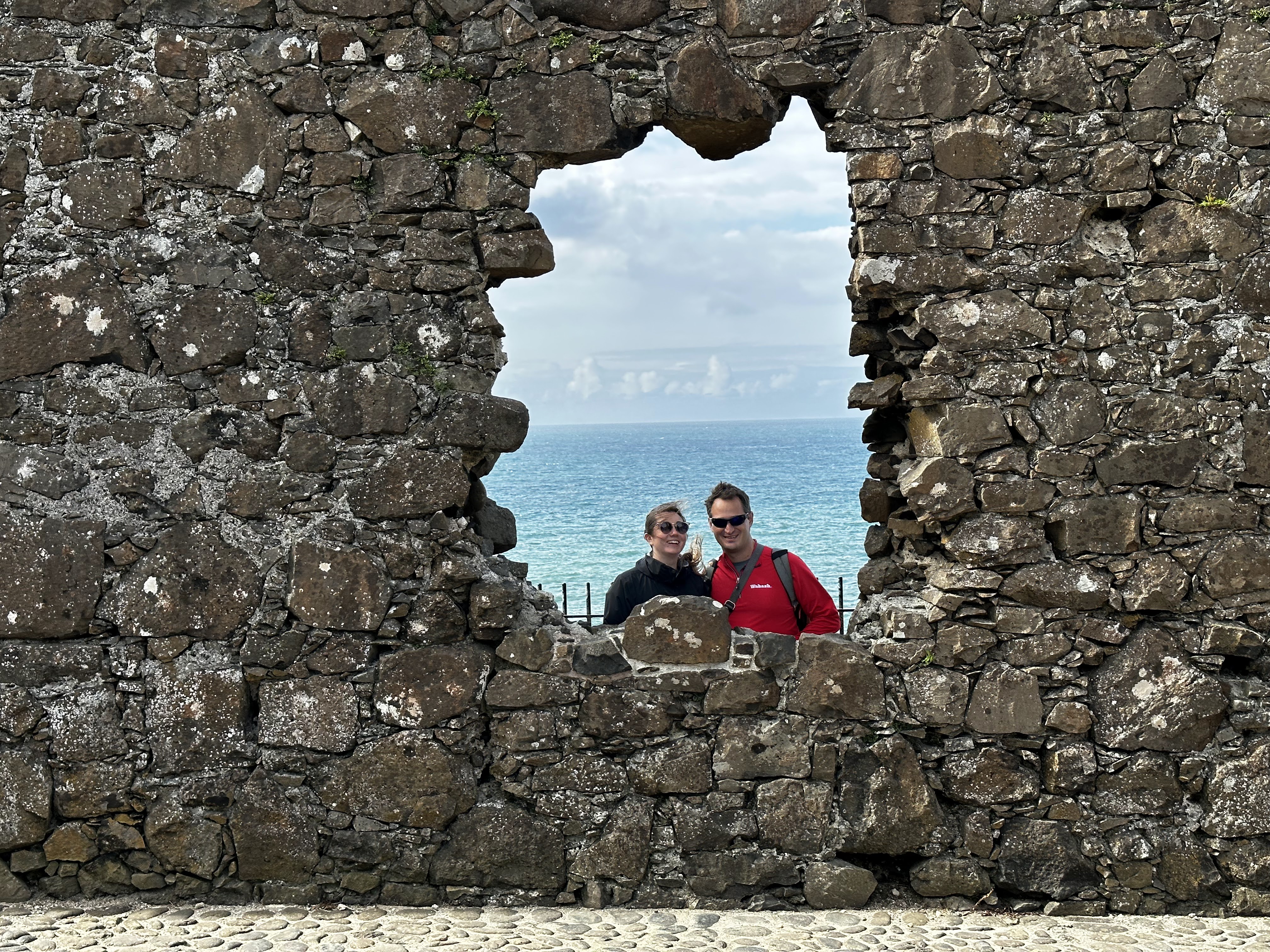
Because we had retooled our plan to stop back by the Carrick-a-Rede Rope Bridge, we started our way back east along the Causeway Coast. Our first stop was Dunseverick Castle (Dún Sobhairce), which was first fortified by the ancient chieftain Sobhairce by at least the 5th century, became the center for the Earls of Ulster between 1250 and 1350, and the stronghold for the MacDonnells beginning in 1560. Saint Patrick is recorded as having visited the castle where he baptized Olcán, the future Bishop of Ireland. The castle was finally captured and destroyed by Cromwell's troops in the 1650s and all that remains today is the gatelodge.
From there, we drove east, passing the white sand beaches of Whitepark Bay. The four of us spent an embarrassing amount of time discussing how it could possibly be that there were people down on the beach on such a chilly and rainy morning only to finally realize that they weren’t people at all, but cows! Our next stop was down winding and treacherous road in Ballintoy (Baile an Tuaighe) Harbor, which is where they filmed a number of scenes for Game of Thrones, including those for the Iron Islands’ Lordsport Harbour. The harbour was built in large part because of the nearby lime kiln that was built in the 1700s and redeveloped a century later. Additionally, in the late 1800s, sett stones, hewn in nearby quarries were exported from the harbour to pave the streets of fast-developing industrial cities like Dublin and Liverpool. The harbour offered yet another incredible view of the northern Irish landscape.
 Finally, it was time to head back to the Carrick-a-rede Rope Bridge, and I hadn’t gotten any notification that the bridge was closed today, so we were all excited and hopeful. The bridge itself is 60-feet long and 3-feet wide, spanning the 90-foot-deep chasm between the sea cliffs and the tiny island of Carrick-a-Rede. The island's name comes from the Gaelic Carraig-a-Rade, which means "The Rock in the Road." It was named such because the island represented an obstacle for the migrating Atlantic salmon. The rope bridge was first erected by fishermen in 1755, but the fish are long gone now. because of fishing pressure at sea and river pollution. The last fish was caught at Carrick-a-Rede in 2002 when the last fisherman on the island retired after 30 years.
The trail from the car park to the bridge was a little over a mile, winding up and down the sea cliffs and past fields and fields of sheep. As we were walking down, we passed a group of four girls - seemingly American college students - who made a series of less-than-astute observations about the Troubles and the political challenges of Northern Ireland. The penultimate decision they reached to resolve these political challenges was that if they just changed the name of Londonderry to “Derry Londonderry.” Apparently that simple change had the power to resolve literal centuries of religious and political disagreement. At that point, I had to speed walk to get as far away from their ignorant idiocy as possible.
The bridge and the island were both really cool! Kati had been on the fence about crossing the bridge before the trip, but managed to summon the courage to do it (and enjoy it). There’s still an old fisherman’s house built into the steep side of the island and all I could think about the whole time was how it just doesn’t seem possible to live in a house like that…on an island like that! Like so many things along the Causeway Coast, it was just mind blowing. Equally mind blowing was the fact that, on our walk back, Kati turned to me and said, “Is she wearing a Transy jacket?!” As it turns out, not only was she wearing a Transy jacket, but her husband (also wearing a matching jacket) is the President of Transylvania University! We stopped to chat with them for a few minutes and marvel about how small the world is and how, without fail, when we go somewhere, we run into other people from Kentucky.
We made one last stop in County Antrim before setting off for the wild Atlantic coast of Donegal in Portrush (Port Rois) to grab a quick bite to eat. Portrush was packed with people and bears a lot of similarities to the Jersey Shore. It’s a seaside resort town and the focal point of the downtown area is a boardwalk full of carnival rides, putt putt, and the likes. We tried to stop off at Kiwis Brew Bar for lunch and some craft beer, but we got there at noon and they didn’t start serving food until 1:00. As much as we wanted to try it out, we had places to be and no time to linger. Unfortunately, the next several places along the street that we tried to stop at to eat were also closed, so our options were limited. Finally, we found nondescript hotel restaurant to get a burger and head back into the Republic of Ireland and on to the Irish equivalent of the Wild Wild West - County Donegal.