Showing posts with label Nosy Tsarabanjina. Show all posts

Sunday, October 18, 2015

Our Last Day on Tsarabanjina

October 15 -- It was our last full day on Tsarabanjina, so we decided to take it easy and soak in as much of the beauty as we could.  After a lazy morning, we took another snorkeling trip, this time around the point at the far end of the north beach.  The amount of sea life right off of the beach was simply amazing.  It was like swimming through a forest of coral.  We saw another puffer fish, sea anemones, sea slugs, and a few giant starfish.

The rest of our day was spent walking along the beaches, drinking at the bar, and relaxing at our bungalow.  One of my favorite parts of Tsarabanjina are the three iconic blue swinging benches scattered between the north and south beaches.  They offer the perfect contrast to the white sand beaches and provide an ideal spot to watch the sun set over the island.

Where Has the Time Gone?

The Traveler's Palm
October 14 -- It feels like only yesterday that we arrived on Tsarabanjina, yet our stay is almost over.  Today was very relaxing.  In the morning, we took a quick botanical walk from the restaurant to the reception and learned about a number of plants.  Unfortunately, our guide only knew the Italian name of many of the plants, so my ability to describe them here is limited.  Nevertheless, we saw jackfruits, pink peppercorn plants, papaya trees, vanilla plants, and a variety of incredibly beautiful (but unnamed) flowers.

Out of all of Madagascar's flora, its palms are perhaps the most impressive.  There are approximately 200 different species of palm trees on Madagascar, and 189 of those are found nowhere else on Earth.  The adaptations are astounding.  For example, there is one type of palm that, rather than growing seeds, it sprouts young buds up its trunk that subsequently fall off and become whole trees.  Yet, as impressive as the Malagasy palms are, the two most impressive species are not actually palms at all.  The most famous -- the traveler's palm -- found its was to being the logo for Air Madagascar.  It's actually a species of banana tree, but it looks like a palm and its giant leaves collect watter inside their base so a thirsty traveler need only take a machete to one of its leaves to find water.  The second "false" palm is commonly called a Madagascar palm.  In truth, it's a large succulent, called a pachypodium because it looks like an elephant's leg.  The tree is covered in spines that serve the dual purpose of keeping lemurs away from the tree's delicious fruits and collecting/storing water.  In other parts of the country, the pachypodium is referred to as a "tourista trap" because tourists will grab it to stabilize themselves, not seeing the spines on the dark gray bark.
Kati Admiring the Sunset
After a long day relaxing on the beach, the staff treated all of us to a bit of a party.  We had an aperitivo on the beach, complete with a Malagasy band, dancing, and some great appetizers.  There were chicken skewers (with some of the juiciest chicken I've ever had), several kinds of fish and beef carpaccio, fresh oysters, and a Malagasy take on pizza.  We befriended a nice British couple from London that had to come to the island by helicopter because Air Madagascar (aka 'Air Maybe') changed their flight at the last minute and they arrived too late to take a boat to the island.

For dinner, Kati had some mediocre lamb and I had some really good calamari, both paired with an excellent Malagasy red wine (yes, I drank red wine with calamari, and it was great).  Between the many aperitivo drinks and our bottle of wine at dinner, Kati and I were both a bit inebriated and more than a little exhausted, so we started the trek back to the south beach early, stopping to admire the star-filled sky for a bit before turning in for the night.

Beneath the Malagasy Sun

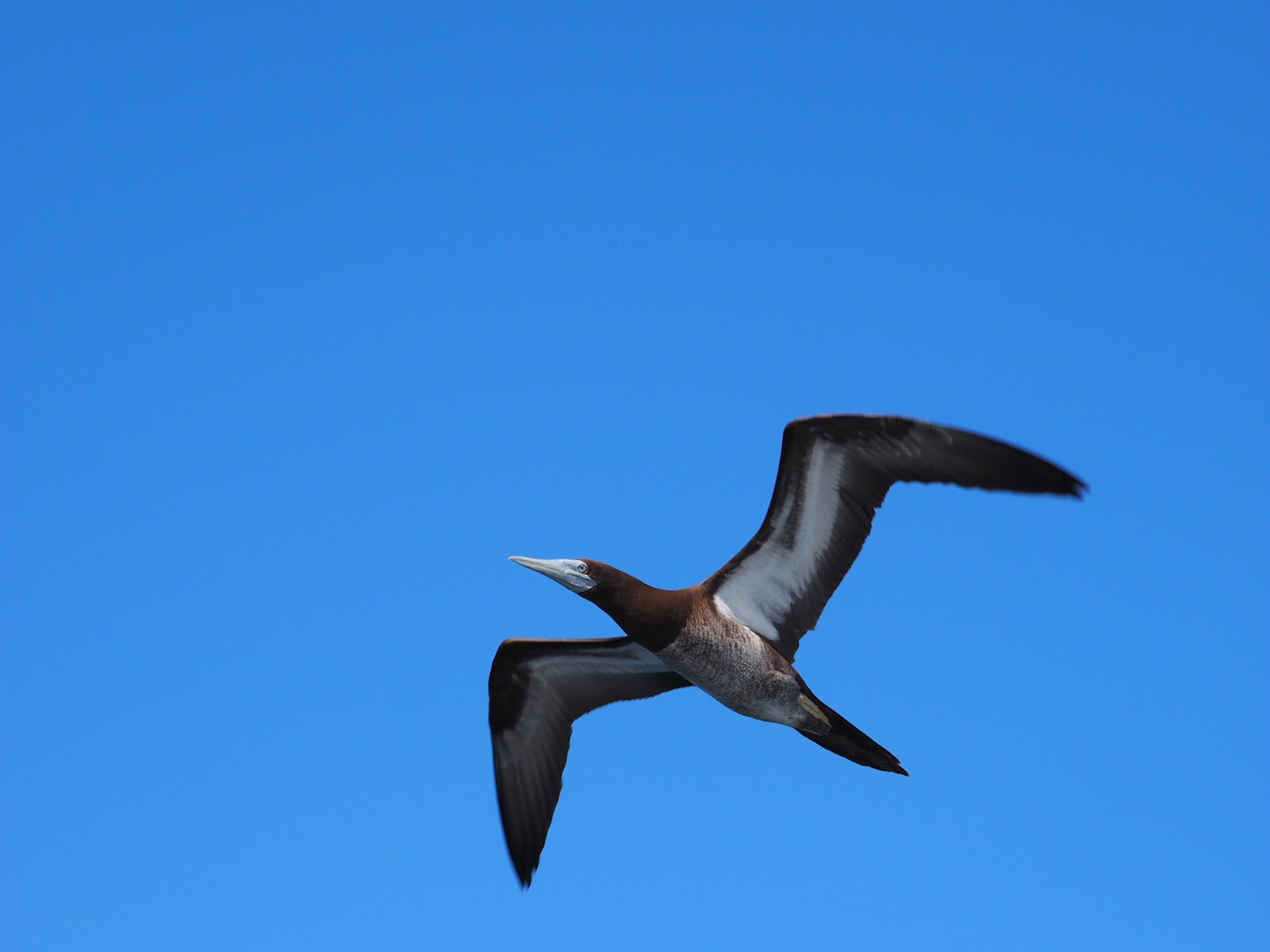
Brown Boobie Flying
October 12 -- We spent yesterday morning relaxing by the beach and soaking in the rays.  The original plan was to spend the morning walking around the perimeter of the island, but the activities of the night before gently persuaded us to forego significant activities in the morning.

After lunch, however, we had a busy day.  At 3:00, we jumped on a boat to go birdwatching.  I never thought that I would say this, but I was so excited to see the birds.  The primary reason for this is that one of the small islands just off the coast of Tsarabajina is home to a pair of Madagascar fish eagles!  They're beautiful birds -- kind of like a bald eagle, but brown and a bit featherier -- and they're critically endangered.  Obviously, seeing one of the rarest birds in the world is a pretty exciting prospect and I've been looking for them our entire trip.  We saw one immediately, perched on a tree, looking right at us.  It was amazing.

From there, we pushed out to a set of four islands called Les Quatre Freres (the Four Brothers).  They're four large lumps of basalt, rising 50-90 meters from the sea.  Two of them -- Nosy Beangovo and Nosy Betalinjona -- are home to large populations of birds.  We saw tons of brown boobies (relatives to the more commonly known blue-footed boobie), brown noddies, frigate birds, and white-tailed tropic birds.  We got really close to a few colonies of these birds and it was really cool.  I never thought that birdwatching could be as fun as it is before we came to Madagascar.
Sunset on Tsarabanjina  

As soon as we landed back on Tsarabanjina, we rushed over to get massages.  The spa is in a small, three-sided bungalow at the end of the south beach.  It looks out over the ocean and we got to listen to the waves crashing onto the rocks throughout our massage.  The experience was incredibly relaxing.

We were both pretty spent after dinner and opted out of another late night at the bar.  The sun had taken its toll, so we turned in around 10:00 to rest up for yet another exciting day.

The Sealife of Tsarabanjina

Kati and Me Snorkeling 
October 11 -- Our first day on Tsarabanjina was incredible.  In the morning, we stopped in to look at the island's turtle hatchery.  Every year, several different kinds of sea turtles come to Tsarabanjina to lay their eggs.  Each female lays approximately 400 eggs and only about one out of every 1,000 will make it through the perilous journey down the beach and into the open ocean.  Because the survival rate is so low, the island staff does their best to save a few turtles that aren't going to make it and care for them until they can be released into the wild.  They currently have two hawksbill turtles and two loggerhead turtles in the hatchery, but will probably release them in the next month or two.

Later in the day, we went snorkeling at a reef around the island.  It was Kati's first time snorkeling and she was a bit concerned at first, but by the end, she didn't want to get out of the water!  Even though it was a bit overcast, the colors were still amazing and we saw just about every local reef fish possible.  Our guide is Milanese and spent the last two years working at the sister resort in the Maldives (tough life!).  She was great with helping acclimate Kati to breathing through her mouth.  She even took my camera to do some deep dives to the base of the reef and take pictures for us.

We spent our afternoon relaxing on the beach before walking over for dinner and drinks.  They were having a Malagasy party, so we all donned lambas (i.e., sarongs) to learn how to wear them and how to dance.  The party started with cocktails on a viewpoint where we had some fantastic kebabs and watched the sunset.  Afterwards, we went into the bar for a quick lesson on Malagasy history.  They used Kati and me as models for the various ways you can wear a lamba and then had a few of the locals, dressed in traditional garb, show us some Malagasy dancing (and force us into doing some ourselves).  It was a lot of fun.

During the ordeal, we befriended a couple from Scotland - Matt and Rachel.  He is a psychiatrist and she is a children's psychologist.  They were a very interesting pair and had also done a fair amount of traveling on mainland Madagasacar.  We ended up getting dinner with them, swapping travel stories, and then spent the evening together at the bar.  In the spirit of the evening, there was a traditional Malagasy dinner -- a pumpkin soup to start, followed by a cooked octopus mixture and some sort of local cake-like dessert.  The soup was very good.  Kati liked the rest of it, but I certainly did not.  The octopus just seemed too chewy and fishy.  I've had octopus cooked well, and this just did not meet my particular tastes.

Kati and Rachel were intrigued by the various infused rums that they make on the island and set out
Kati, Erica, and Jean-Michelle
to try all of them (I'm pretty sure they succeeded).  Some of them -- the ginger-cinnamon and vanilla -- were very good.  Others, like the banana-infused rum didn't do it for me.  Then there was the weird one: Citronella-infused rum.  It smelled like deet and it didn't taste much better.  Even the locals were laughing when Kati and Rachel were asking about it.  They had hoped that, even if it tasted bad, it would help keep the mosquitos away.  Henri, however, was quick to point out that it would probably keep the mosquitos out of their stomachs, but little else.  

The four of us closed the bar out around midnight and walked home over the "secret" rock path between the bar and the south beach.  Kati not only spotted, but caught a pretty large crab by doing what, by all accounts, was a very distracting dance that confused the crab so she could sneak behind it and grab it from the back!  All-in-all, it was a wonderful day.

Hey, Tsarabanjina...

Wow!!  Constance Tsarabanjina isn't particularly easy to get to, but boy is it worth it!  We took a 1.5 hour flight from Tana to Nosy Be (pronounced 'noosey bay'), then got in a car for a 40 minute drive to the beach by the Manga Soa Lodge where we got on a boat for the hour ride to Nosy Tsarabanjina.  The name means "good-looking island," and man is it accurate!  We finally arrived to a beach full of waving staff members around 6:00 p.m.  (Though they claim to be an hour ahead of Tana here, the internet and my iPhone disagree.)  The sun was setting and it could not have been more perfect.

Nosy Tsarabanjina is a private island occupied only by our hotel - Constance Tsarabanjina.  There are 25 bungalows spread out over two beaches - one on the south and one on the north.  There is also a third beach in front of the restaurant and bar.  Henri, the manager, walked us to our bungalow, stopping to show us the helipad, the ping-pong table, and the beach volleyball court.  Our bungalow (#9) is on the south beach.  Like all of our neighbors, we have our own shaded porch, hammock, and private section of the beach.  The sand is as white as I've ever seen, and the ocean is an amazing teal-blue.  It is hard to imagine a place more beautiful or relaxing than Tsarabanjina.

To make things even better, there is a direct flight from Milan to Nosy Be, so everyone here speaks
Italian and many of the guests are Italian.  It's nice being able to understand most people again!  Nevertheless, Kati and I always make a point to speak in Malagasy as much as possible to the staff.  It's funny because you can tell that nobody does that around here.  All of the Europeans come down, not knowing a word of Malagasy, and just expect the staff to speak to them in their own languages.  I love seeing the look of shock on their faces, followed by genuine appreciation, when we make the effort and speak to them in their native tongue.

Not only is Tsarabanjina mind-blowingly beautiful, the service is impeccable and the food is outstanding.  For our first dinner we had zucchini flan and crusted fish appetizers, followed by some amazing grilled prawns (each bigger than my hand), and a chocolate mousse cake for dessert.  It's hard to beat that coupled with a good wine list and an attentive staff willing to make you a wide variety of island frufru drinks.  It's going to be a great week!